
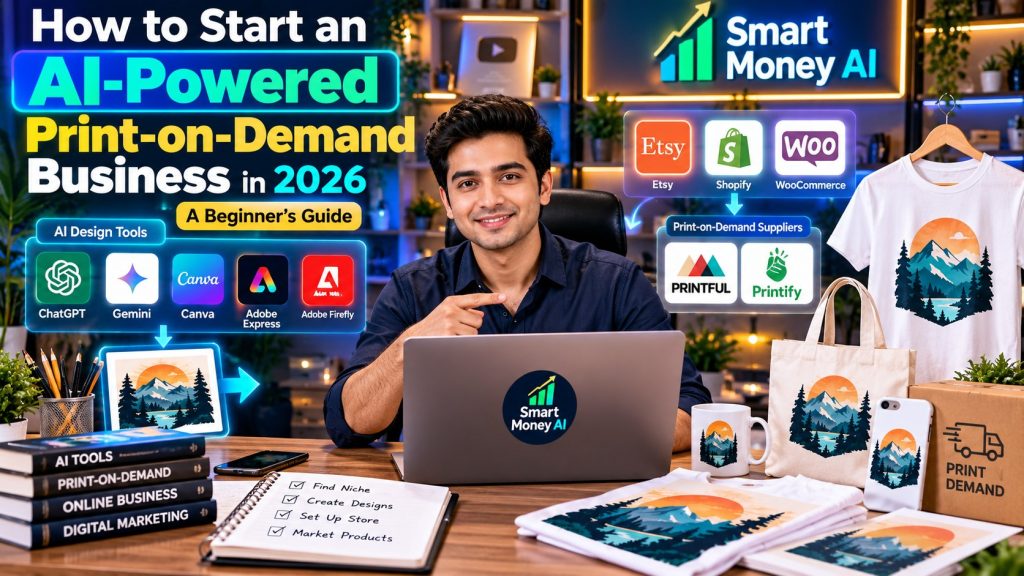
Starting an online business does not always mean buying products in bulk, renting storage space, or managing a warehouse. Print-on-demand (POD) offers another approach: products are generally manufactured after a customer places an order.
With artificial intelligence becoming more accessible, beginners can also use AI tools to research product ideas, explore design concepts, prepare descriptions, and organize parts of their business.
If you’re exploring other AI-assisted business opportunities, read our guide on how to start an online business with AI
But an AI-powered print-on-demand business is not an automatic income system. Successful operations still require original designs, reliable suppliers, appropriate pricing, marketing, customer service, and careful attention to intellectual property rights.
If you’re wondering how to start an AI-powered print-on-demand business in 2026, this guide explains the process step by step.
You’ll learn how print-on-demand works, which products to consider, how AI can assist with design, how to choose suppliers, and what to check before launching your first store.
Table of Contents
1. What Is a Print-on-Demand Business?
Print-on-demand is a business model in which products are produced after customers place orders.
Instead of purchasing hundreds of printed T-shirts in advance, a seller creates a design and makes it available on a product through an online store.
When someone purchases the item, a print-on-demand provider typically handles production and shipping according to its service agreement.
Common print-on-demand products include:
- T-shirts.
- Hoodies.
- Sweatshirts.
- Mugs.
- Tote bags.
- Posters.
- Wall art.
- Notebooks.
- Phone cases.
- Stickers.
The seller usually manages product selection, design, listings, pricing, branding, marketing, and customer relationships.
The supplier handles some or all of the printing and fulfillment.
How Does Print-on-Demand Work?
A typical order follows this process:
- The seller creates an original design.
- The design is uploaded to a print-on-demand platform.
- The seller selects products and creates listings.
- A customer places an order.
- The supplier receives the order.
- The product is printed.
- The supplier ships the order.
- The seller handles customer communication and any responsibilities under the sales agreement.
Exact workflows vary by provider and selling platform.
Print-on-demand can reduce the need for upfront inventory, but the seller remains responsible for operating a legitimate business.
2. What Makes an AI-Powered Print-on-Demand Business Different?
An AI-powered print-on-demand business uses artificial intelligence to assist with selected tasks.
For example, AI may help you:
- Brainstorm niche ideas.
- Explore original design concepts.
- Create initial artwork.
- Draft product descriptions.
- Organize a content calendar.
- Research customer questions.
- Develop marketing ideas.
- Improve business workflows.
However, AI does not replace design judgment or product testing.
An AI-generated image might look attractive on a computer screen but print poorly because of low resolution, unsuitable colors, or confusing details.
Likewise, an AI-generated product description might contain inaccurate claims about fabric, sizing, or delivery times.
Every important output needs review.
The main principle: Use AI to support creativity and efficiency while maintaining human responsibility for the finished product.
3. Why Consider Print-on-Demand in 2026?
Print-on-demand has several characteristics that may appeal to beginners.
No Need to Purchase Large Amounts of Inventory
Traditional retail businesses may purchase stock before knowing whether customers will buy it.
With print-on-demand, production generally begins after an order is placed.
This can reduce inventory-related risk.
If you prefer selling downloadable products without physical production or shipping, explore our guide on how to sell digital products online in 2026.
However, sellers may still face expenses for samples, software, storefronts, advertising, returns, and order fulfillment.
Opportunity to Test Different Designs
You can explore a small collection of original designs without manufacturing every variation in advance.
Customer feedback may help you decide which products deserve further development.
Flexible Product Selection
A design concept might work on a poster, tote bag, or notebook.
However, each product requires suitable artwork dimensions and careful placement.
A design that looks good on a mug may not work well on a T-shirt.
Access to Online Selling Platforms
Print-on-demand services may integrate with ecommerce platforms and marketplaces.
This can simplify some technical steps.
But platform compatibility, account eligibility, fees, and policies should be checked before starting.
Creative Skill Development
Building a print-on-demand store can help you learn:
- Graphic design.
- Product research.
- Ecommerce operations.
- Customer communication.
- Digital marketing.
- Pricing.
- Quality control.
These skills can remain useful even if your first product collection does not succeed.
To strengthen your skills in design, digital marketing, and online business, explore our guide to 10 essential digital skills for beginners in 2026.
4. Choose a Specific Print-on-Demand Niche
One of the most important decisions is deciding who your products are for.
A niche is a particular audience or area of interest.
For example, instead of creating generic motivational T-shirts, you might develop original designs for people who enjoy gardening.
Other potential audiences include:
- Book lovers.
- Pet enthusiasts.
- Teachers.
- Travelers.
- Home-office workers.
- Artists.
- Outdoor hobbyists.
- Coffee enthusiasts.
- Fitness hobbyists.
- People interested in minimalist decor.
These are examples for research, not guaranteed profitable niches.
Why a Specific Niche Matters
A clearly defined audience makes it easier to develop a consistent product collection.
For example, a store focused on home-office decor could offer coordinated posters, mugs, and desk accessories.
The designs could share a recognizable visual style.
A general store selling unrelated products may be harder for customers to understand.
How to Research a Niche
Start by examining customer interests and existing products.
Ask:
- Who would use this product?
- What interests or problems does the audience share?
- What visual styles are common?
- What complaints appear in customer reviews?
- What could make an original design more useful or appealing?
Avoid choosing a niche only because an AI tool labels it as profitable.
Real customer demand requires independent validation.
5. Use AI to Research Product Ideas
AI assistants such as ChatGPT or Google Gemini can help organize your research.
For example, you could ask:
“Suggest 15 original print-on-demand product concepts for people who enjoy gardening. Focus on practical product types, visual themes, and customer interests. Avoid existing brands, copyrighted characters, and trademarked phrases.”
The results can provide starting ideas.
However, AI may suggest concepts that are too generic, already widely used, or legally problematic.
Turn Broad Ideas Into Specific Concepts
Suppose your chosen niche is gardening.
Broad idea:
“Gardening T-shirt.”
More specific concept:
“An original botanical illustration featuring a collection of herbs, designed for a neutral-colored T-shirt.”
The second concept gives you a clearer creative direction.
Validate the Product Idea
Explore relevant marketplaces and examine:
- Product types.
- Customer reviews.
- Common design styles.
- Pricing.
- Product materials.
- Shipping expectations.
Look for unmet needs rather than copying successful listings.
Competition may indicate demand, but it does not guarantee that your products will sell.
6. Choose the Right Products for Your Store
Beginners may be tempted to offer every available print-on-demand product.
A smaller collection is usually easier to manage.
T-Shirts
T-shirts are common print-on-demand products.
Important considerations include:
- Fabric composition.
- Available sizes.
- Print placement.
- Color options.
- Washing instructions.
- Supplier quality.
A design should remain readable and attractive across the intended sizes.
Mugs
Mugs can work well for original illustrations and simple typography.
Check:
- Print area.
- Material.
- Capacity.
- Care instructions.
- Packaging.
- Shipping reliability.
Do not make claims such as dishwasher-safe unless the supplier confirms them.
Posters and Wall Art
Wall art may suit original illustrations, educational graphics, and decorative designs.
Image resolution is particularly important.
A low-resolution image can look acceptable on a screen but appear blurry when printed at a large size.
Tote Bags
Tote bags may be suitable for simple illustrations and bold graphic designs.
Review the material, dimensions, print area, and care instructions.
Notebooks
Notebooks can support original cover artwork.
Check page count, paper specifications, binding type, and available customization options.
Start With Two or Three Products
For a first collection, consider a small group of products that fit your niche.
This makes it easier to review samples, compare suppliers, and maintain consistent quality.
7. AI Tools That Can Help With Print-on-Demand
Different tools support different parts of the workflow.
If you’re new to artificial intelligence, explore our guide to the 10 best AI tools for beginners to understand how these tools can support creative and business tasks.
| Tool | Potential Use |
|---|---|
| ChatGPT | Research planning, brainstorming, descriptions |
| Google Gemini | Concept exploration and writing assistance |
| Canva | Layout design and product graphics |
| Adobe Express | Graphic design and content preparation |
| Adobe Firefly | AI-assisted visual concept creation |
| Shopify | Ecommerce storefront management |
| Printful | Print-on-demand production and fulfillment |
| Printify | Access to print-on-demand production options |
Not every tool listed is primarily an AI application.
Features, prices, commercial-use terms, and integrations can change.
Do You Need Every Tool?
No.
A beginner might start with:
- One AI assistant.
- One design application.
- One print-on-demand provider.
- One selling platform.
Add other tools only when they solve a real business problem.
Using more software does not automatically produce better products.
8. Step-by-Step: Create an Original AI-Assisted Design
Let’s imagine you’re creating a botanical-themed poster.
Step 1: Define the Design Concept
Decide what the artwork should communicate.
For example:
“A minimalist botanical illustration featuring three common kitchen herbs on a warm cream background.”
This gives you a clear subject and visual direction.
Step 2: Prepare a Design Brief
A design brief might specify:
- Intended product.
- Target audience.
- Visual style.
- Main subject.
- Preferred colors.
- Required dimensions.
- Text requirements.
- Commercial-use considerations.
Step 3: Generate or Develop the Artwork
Use an appropriate design tool to create an initial concept.
If using generative AI, review the tool’s current commercial-use terms.
Avoid requesting protected characters, copied artwork, or designs that imitate a particular brand.
Step 4: Review the Output
Check for:
- Unwanted visual artifacts.
- Incorrect spelling.
- Distorted shapes.
- Poor composition.
- Unclear details.
- Unintended similarities to existing designs.
AI-generated artwork often needs additional editing.
Step 5: Prepare the Print File
Follow the supplier’s specifications for:
- File dimensions.
- Resolution.
- Supported formats.
- Transparency.
- Color handling.
- Safe printing areas.
Do not assume that enlarging a small image automatically makes it suitable for high-quality printing.
Step 6: Test the Design on a Product Mockup
A mockup helps you preview placement.
Check whether the design appears too small, too large, or poorly positioned.
Remember that mockups are simulations, not guarantees of final print quality.
Step 7: Order a Sample
Whenever practical, inspect a physical sample before promoting the product extensively.
This helps you evaluate the real customer experience.
9. Understand Copyright, Trademarks, and AI-Generated Designs
Intellectual property is one of the most important issues in print-on-demand.
A design can be visually attractive and still be unsuitable for commercial sale.
Copyright
Copyright may protect original creative works such as illustrations, photographs, and other artistic material.
Do not copy artwork from websites or marketplaces without appropriate rights.
Trademarks
Trademarks can protect brand names, logos, slogans, and other identifiers used in commerce.
A phrase that seems ordinary may be protected in connection with certain goods or services.
Before using names or phrases commercially, investigate potential conflicts.
In the United States, the USPTO provides trademark information and search resources.
AI-Generated Content
AI-generated material raises additional questions about ownership, licensing, and copyright protection.
The treatment of AI-generated works can depend on the level of human authorship and applicable law.
Do not assume that using an AI image generator automatically gives you exclusive rights to every output.
Commercial-Use Terms
Review the design platform’s license and the terms for any fonts, graphics, photographs, or other assets.
Some assets may be permitted in finished designs but not for standalone resale.
Avoid Misleading Associations
Do not use celebrity names, sports team logos, fictional characters, or brand identities in ways that infringe rights or falsely suggest endorsement.
When a proposed design raises legal concerns, obtain qualified guidance before selling it.
10. Choose a Reliable Print-on-Demand Supplier
The supplier affects the product customers receive.
Two commonly considered providers are Printful and Printify.
Their business models, production networks, product catalogs, and integrations may differ.
To explore available products, printing services, and fulfillment options, visit the official Printful website.
To compare print-on-demand products, printing providers, and fulfillment options, explore the official Printify website.
Compare Product Quality
Review available product specifications.
Consider:
- Material quality.
- Print methods.
- Available sizes.
- Product consistency.
- Care instructions.
Compare Fulfillment and Shipping
Check:
- Production estimates.
- Shipping destinations.
- Shipping charges.
- Tracking availability.
- Delivery policies.
- International shipping options.
Delivery times can vary, especially during busy periods.
Review Return and Replacement Policies
Understand how the supplier handles:
- Damaged products.
- Printing defects.
- Incorrect items.
- Lost shipments.
- Customer sizing mistakes.
The supplier’s policies may not fully cover your responsibilities to customers.
Evaluate Integration Options
Confirm whether the supplier works with your chosen store or marketplace.
Check which parts of order processing are automated.
Order Samples
A sample can reveal problems that are not obvious in online previews.
Check printing, fabric or material quality, packaging, and overall appearance.
11. Where Can You Sell Print-on-Demand Products?
Your selling platform determines how customers find and purchase your products.
Etsy
Etsy may be suitable for certain original or creatively designed print-on-demand products that comply with its policies.
Review its current rules for production partners, seller disclosures, and AI-related content.
Shopify
Shopify provides ecommerce tools for operating a branded online store.
It may be useful for sellers who want greater control over their website and customer experience.
However, subscription fees and other operating costs should be considered.
WooCommerce
WooCommerce is an ecommerce solution for WordPress websites.
It can support physical products and compatible print-on-demand integrations.
This option may appeal to sellers who are comfortable managing WordPress.
Other Marketplaces
Additional platforms may offer print-on-demand selling opportunities.
Each has its own eligibility requirements, fees, intellectual property policies, and product restrictions.
Marketplace or Independent Store?
A marketplace may provide access to an existing customer base, but it can also involve competition and platform dependence.
An independent store provides more branding flexibility but requires you to attract visitors.
Neither approach guarantees sales.
12. How to Set Up Your Print-on-Demand Store
Once you’ve chosen a niche, supplier, and platform, prepare your storefront.
Choose a Business Name
Select a name that reflects your products and audience.
Check for possible trademark conflicts before investing in branding.
Develop a Consistent Visual Identity
Choose suitable:
- Brand colors.
- Typography.
- Logo.
- Product photography style.
- Store layout.
Your branding should support the customer experience rather than distract from the products.
Create Essential Store Pages
A typical store may need:
Homepage: Explain what you sell.
Shop: Display available products.
About: Describe the business and its approach.
Contact: Provide customer support information.
Shipping Information: Explain delivery expectations.
Returns and Refunds: State applicable policies accurately.
Privacy Policy: Explain relevant data practices.
Legal requirements vary by jurisdiction.
Connect Your Supplier
Follow the provider’s official integration process.
Confirm product synchronization, pricing, order processing, and shipping settings.
Test the Store
Check:
- Product pages.
- Mobile display.
- Checkout.
- Payment methods.
- Shipping charges.
- Confirmation emails.
- Order fulfillment settings.
Do not launch until the basic purchase process works correctly.
13. How to Write Effective Product Listings
A product listing should help customers understand exactly what they are buying.
Use a Clear Product Title
A useful title describes the item accurately.
For example:
“Original Botanical Herb Illustration Poster”
Avoid unnecessary keyword repetition or misleading descriptions.
Explain the Product
Describe:
- The design.
- Product type.
- Materials.
- Available sizes.
- Color options.
- Intended use.
- Care instructions.
Use verified supplier information.
Show Accurate Images
Provide mockups or product photographs that represent the actual item.
If possible, include photographs of samples.
Do not present unrealistic AI-generated lifestyle images as photographs of the actual product without appropriate context.
Include Size Information
Customers should understand dimensions and fit.
For clothing, use the supplier’s accurate size chart.
Set Realistic Delivery Expectations
Explain production and shipping estimates without guaranteeing dates you cannot control.
Review AI-Generated Descriptions
AI can help draft product listings, but it may invent details.
Verify every material, dimension, feature, and policy statement.
14. How to Price Print-on-Demand Products
Pricing requires careful calculation.
A sale does not automatically produce a profit.
Understand Your Costs
Possible costs include:
- Base product cost.
- Printing.
- Shipping.
- Marketplace fees.
- Payment processing.
- Advertising.
- Software subscriptions.
- Refunds and replacements.
- Taxes and other obligations.
Hypothetical Pricing Example
Imagine a T-shirt with the following costs:
| Item | Amount |
|---|---|
| Customer selling price | $28 |
| Product and printing | $13 |
| Shipping paid by seller | $5 |
| Transaction-related fees | $2 |
| Remaining amount | $8 |
The $8 remaining is before other expenses such as advertising, software, refunds, and applicable taxes.
These figures are hypothetical and do not represent current supplier pricing.
Consider the Customer’s Perspective
A product must provide value relative to its price.
Customers may consider design originality, quality, shipping, brand reputation, and competing alternatives.
Avoid Competing Only on Price
Extremely low prices may leave little room for unexpected costs.
Instead, focus on creating products with clear value and dependable quality.
15. How to Market an AI-Powered Print-on-Demand Store
Marketing helps potential customers discover your products.
The most useful approach depends on your niche and resources.
Search Engine Optimization
Use clear product titles, accurate descriptions, and helpful website content.
For example, a store selling original botanical posters might publish educational content about decorating a home workspace with plant-inspired artwork.
The content should be genuinely helpful.
Pinterest may be relevant for visually oriented products such as wall art, stationery, and home decor.
Create attractive, accurate product images.
Instagram and Short Videos
Short videos can demonstrate product details, packaging, or design development.
If you use AI-generated promotional scenes, avoid creating a misleading impression of the physical product.
Educational Content
A store can build interest by sharing relevant information.
For example, a stationery brand might publish organization tips.
A gardening-themed brand might share general plant-care information.
Email Marketing
Customers who choose to receive updates may appreciate product announcements and useful content.
Follow applicable consent and unsubscribe requirements.
Paid Advertising
Advertising can increase expenses quickly.
Understand your costs and test cautiously before expanding campaigns.
No advertising strategy guarantees sales.
16. How AI Can Support Your Marketing Workflow
AI tools can help with planning and drafting.
Content Calendars
An AI assistant can suggest a four-week content schedule based on your product niche.
Review the ideas and select those that are genuinely relevant.
Product Description Drafts
Provide verified product details and ask for a clear, customer-friendly draft.
Social Media Captions
AI can help prepare caption variations.
Avoid publishing repetitive or exaggerated promotional claims.
Customer FAQ Drafts
Use actual store policies and supplier information to prepare helpful answers.
Feedback Organization
AI may help summarize non-sensitive customer feedback and identify recurring issues.
However, customer information should only be processed with appropriate permissions and safeguards.
Workflow Checklists
You can use AI to create checklists for:
- New product launches.
- Listing reviews.
- Sample inspections.
- Customer support.
- Monthly expense reviews.
The purpose is to improve consistency, not eliminate oversight.
17. Managing Orders, Returns, and Customer Service
Print-on-demand sellers need to understand their responsibilities after a purchase.
Monitor Orders
Check whether orders are transmitted correctly to the supplier.
Watch for production delays and fulfillment problems.
Communicate Clearly
If an order is delayed, provide accurate information.
Avoid promising delivery dates without confirmation.
Handle Product Problems
Customers may report:
- Printing defects.
- Incorrect sizes.
- Damaged items.
- Missing shipments.
- Quality concerns.
Review the supplier’s procedures and applicable consumer rights.
Understand Refund Responsibilities
A supplier’s policy does not necessarily remove the seller’s legal obligations.
Publish fair, accurate policies that comply with relevant laws and marketplace rules.
Learn From Complaints
Repeated issues may indicate a supplier problem, unclear listing, or unsuitable product.
Use customer feedback to improve the business.
18. Common Mistakes Beginners Should Avoid
Uploading Hundreds of Designs Without Testing
A large product catalog does not guarantee customer interest.
Begin with a manageable collection and evaluate quality.
Copying Popular Designs
Imitating existing artwork, slogans, or brands can create intellectual property problems.
Develop original concepts.
Trusting AI Images Without Editing
AI-generated designs may contain spelling mistakes, visual distortions, or unsuitable details.
Review every file carefully.
Ignoring Print Specifications
Incorrect resolution or dimensions can produce disappointing results.
Follow the supplier’s technical requirements.
Skipping Physical Samples
Mockups cannot fully demonstrate fabric, print quality, or packaging.
Samples are valuable whenever practical.
Miscalculating Profit
Remember to include fees, shipping, advertising, and other expenses.
Promising Passive Income
Print-on-demand may automate production, but marketing, quality control, customer service, and business management still require work.
Neglecting Customer Trust
Misleading images, unclear policies, and poor communication can damage a business.
Transparency and reliability matter.
19. A Practical 30-Day Print-on-Demand Launch Plan
This sample plan provides a structured way to begin.
Week 1: Research and Planning
- Choose one niche.
- Define the target audience.
- Research product ideas.
- Review competing products.
- Compare print-on-demand providers.
- Identify intellectual property concerns.
Goal: Develop a realistic product concept.
Week 2: Design and Testing
- Create a small collection of original designs.
- Review AI-generated artwork.
- Prepare files according to print specifications.
- Generate product mockups.
- Order samples where practical.
- Revise designs based on initial findings.
Goal: Prepare products that meet quality expectations.
Week 3: Store Setup
- Choose a selling platform.
- Create your storefront.
- Connect the supplier.
- Prepare product listings.
- Calculate prices.
- Add necessary policies.
- Test checkout and order processing.
Goal: Make the store operational.
Week 4: Launch and Review
- Publish the initial collection.
- Share relevant educational or promotional content.
- Monitor customer questions.
- Track expenses.
- Review website or marketplace activity.
- Identify improvements.
Goal: Gather real feedback and learn from the launch.
This is an illustrative timeline, not a guarantee that a store can be launched or become profitable within 30 days.
20. How Much Money Can an AI Print-on-Demand Business Make?
There is no guaranteed income level for print-on-demand businesses.
Results depend on factors such as:
- Product demand.
- Design quality.
- Pricing.
- Competition.
- Supplier costs.
- Marketing.
- Customer satisfaction.
- Returns and refunds.
- Operating expenses.
Hypothetical Revenue Example
Imagine a store sells 30 products during a month at an average price of $25.
Gross sales would be:
30 × $25 = $750
If production, shipping, and transaction-related costs total $510, the remaining amount would be $240 before other business expenses and applicable taxes.
This is an arithmetic illustration, not an expected business outcome.
Some sellers may receive few or no orders, and a store can lose money even when it generates sales.
Focus on understanding costs, creating useful products, and improving customer experience rather than chasing unrealistic earnings claims.
21. Frequently Asked Questions
Can beginners start an AI-powered print-on-demand business?
Yes. Beginners can explore print-on-demand using AI-assisted research and design tools, but they must learn about product quality, supplier requirements, intellectual property, and customer service.
Do I need graphic design experience?
Professional experience is not always required, but basic design knowledge is important. You should understand composition, readability, resolution, and print specifications.
Can I sell AI-generated designs?
Possibly, depending on the tool’s terms, the rights involved, applicable law, and the selling platform’s policies. Commercial-use permission does not necessarily establish exclusive copyright ownership.
Do I need to buy inventory?
Print-on-demand generally does not require bulk inventory purchases. However, sample orders and other startup expenses may still be necessary.
Which products should beginners start with?
A small collection of T-shirts, mugs, posters, or other products suited to your niche may be manageable. Choose products you can test and describe accurately.
Is Shopify required for print-on-demand?
No. Different ecommerce platforms and marketplaces may support print-on-demand integrations.
Is Etsy suitable for print-on-demand?
Etsy may support qualifying print-on-demand products, subject to its current seller, creativity, production-partner, and disclosure policies.
Can ChatGPT create print-on-demand designs?
ChatGPT may help with design ideas, planning, and certain image-related workflows depending on available features. Final artwork still needs appropriate review and preparation.
How much does it cost to start?
Costs vary by platform, supplier, software, samples, advertising, and other business needs. Review current provider pricing before making financial commitments.
Is print-on-demand passive income?
Production and fulfillment may be partly automated, but operating the business still requires ongoing effort.
How long does it take to make a sale?
There is no guaranteed timeline. Some stores may attract customers quickly, while others may receive little or no demand.
Do I need to register a business?
Registration and tax requirements depend on your location, business activities, and applicable laws. In the United States, federal, state, and local requirements may apply.
Final Thoughts
Starting an AI-powered print-on-demand business in 2026 combines creative design, ecommerce, and practical use of artificial intelligence.
AI can help you explore ideas, develop initial artwork, prepare content, and organize business tasks.
But it cannot guarantee that customers will purchase your products.
A reliable print-on-demand business depends on original designs, suitable products, dependable suppliers, accurate listings, responsible pricing, and professional customer service.
Start with one clearly defined audience and a small collection of products.
Test designs carefully, review commercial-use rights, order samples when possible, and calculate your expenses before launching.
As you receive feedback, improve your designs and refine your store.
The goal is not to create the largest number of AI-generated products. It is to build a trustworthy business offering original products that customers genuinely value.
Editor’s Note: This article provides general educational information and does not constitute legal, financial, or tax advice. Print-on-demand platform policies, supplier prices, AI licensing terms, and intellectual property rules may change. Business outcomes vary, and no income or sales results are guaranteed.