
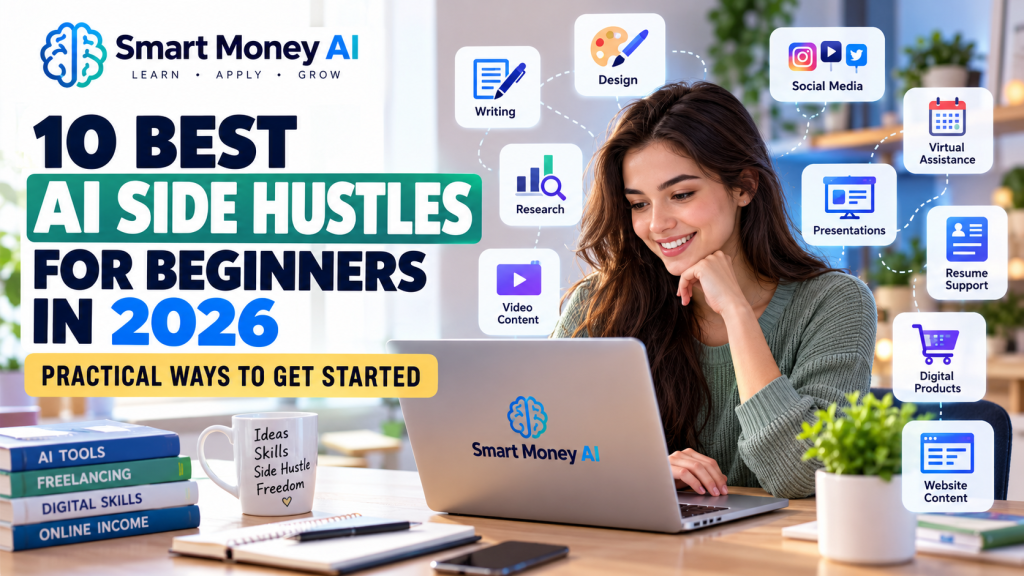
Artificial intelligence is changing how people approach freelance work, digital services, and small online businesses. Tasks that once required specialized software or extensive experience can sometimes be completed more efficiently with the assistance of AI tools.
But can beginners actually use artificial intelligence to develop a side hustle?
The answer is yes, provided they are willing to learn practical skills, deliver useful services, and build trust with customers.
The most promising AI side hustles for beginners are not about pressing a button and automatically earning money. They involve combining AI technology with human creativity, research, communication, and problem-solving.
In this guide, we’ll explore 10 practical AI-assisted side hustle ideas for 2026, the tools that can support each activity, how to get started, and the common mistakes to avoid.
Whether you’re a student exploring future career skills, a professional looking to expand your abilities, or someone interested in online entrepreneurship, this article will help you understand the opportunities realistically.
Important: Side hustles involve uncertainty, and earnings are never guaranteed. Some freelance platforms, payment services, and business arrangements have minimum-age requirements. Younger readers should focus on learning, portfolio development, and age-appropriate opportunities with parent or guardian guidance where needed.
Table of Contents
What Are AI Side Hustles?
AI side hustles are part-time projects or services that use artificial intelligence to assist with work such as writing, design, research, content planning, and business organization.
For example, someone offering presentation design services might use AI to brainstorm an outline and Canva to develop the final slides.
A freelance writer might use an AI assistant to organize research and prepare an initial structure before writing and editing the content.
In both examples, AI supports the process, but the individual remains responsible for the quality of the final result.
Successful AI-assisted work typically requires three elements:
- A useful skill: Something customers genuinely need.
- Appropriate AI tools: Software that supports the work efficiently.
- Human quality control: Reviewing, improving, and verifying the final output.
Understanding this combination is more important than simply knowing how to generate AI content.
Why Are AI Side Hustles Popular in 2026?
AI tools have made many digital tasks more accessible to beginners.
People can now experiment with writing assistants, design tools, research applications, and productivity software without immediately investing in expensive equipment.
Some advantages include:
- Opportunities to practice digital skills from home
- Access to beginner-friendly AI tools
- Flexible project-based learning
- The ability to create portfolio samples
- Opportunities to combine existing interests with technology
- Transferable skills useful for education and employment
However, growing interest in AI has also increased competition.
Customers generally want accurate, original, and useful results rather than generic AI-generated material.
That means learning to deliver quality work remains essential.
10 Best AI Side Hustles for Beginners in 2026
1. AI-Assisted Freelance Writing
Freelance writing involves creating articles, website copy, newsletters, product descriptions, and other written materials.
AI assistants can help writers brainstorm topics, organize outlines, and improve readability.
However, clients still need original writing that communicates accurately with their intended audience.
Recommended AI tools:
- ChatGPT
- Google Gemini
- Grammarly
How to get started:
- Choose a subject you understand or want to study.
- Learn how to research reliable sources.
- Practice writing clear, useful articles.
- Use AI to organize ideas and identify areas for improvement.
- Create two or three polished writing samples.
- Explore appropriate opportunities once you meet relevant platform and legal requirements.
Example AI prompt:
“Create a detailed outline for a beginner-friendly article about organizing a home office. Include practical tips, common mistakes, and a conclusion. Do not invent statistics or product claims.”
Beginner tip: Use AI to assist your writing process, not to replace fact-checking or original thinking.
2. AI-Assisted Graphic Design
Businesses and content creators frequently need graphics for websites, presentations, social media, and promotional campaigns.
AI can support design brainstorming, layout planning, and visual concept development.
However, effective graphic design still requires attention to typography, readability, color, and audience needs.
Recommended tools:
- Canva
- Adobe Express
- AI image-generation tools with suitable commercial-use terms
How to get started:
- Learn basic design principles.
- Practice creating social media graphics and simple promotional layouts.
- Experiment with AI-assisted design features.
- Build a portfolio containing several different design styles.
- Check the licensing and commercial-use terms of any generated assets.
Example AI prompt:
“Suggest three clean social media poster concepts for a neighborhood bookstore promoting a weekend reading event. Include layout ideas, typography recommendations, and accessible color combinations.”
Beginner tip: Attractive designs must also communicate information clearly.
3. AI-Assisted Social Media Content Planning
Social media content planning involves organizing post ideas, creating calendars, and preparing captions for an audience.
AI tools can help brainstorm topics and develop preliminary content schedules.
However, understanding the audience and maintaining an authentic brand voice remain important.
Recommended tools:
- ChatGPT
- Google Gemini
- Canva
How to get started:
- Choose an industry or topic.
- Study the audience’s common questions.
- Prepare a sample weekly content calendar.
- Draft educational captions.
- Create sample visuals.
- Review the content for accuracy and consistency.
Example AI prompt:
“Create a seven-day educational social media content calendar for a beginner-friendly gardening business. Include post topics, caption ideas, and suggested visual concepts. Avoid exaggerated claims.”
Beginner tip: Quality, relevance, and consistency matter more than posting large amounts of generic AI content.
4. AI-Assisted Virtual Assistance
Virtual assistants help individuals and businesses organize administrative tasks.
Services may include preparing schedules, formatting documents, drafting routine communications, and organizing project information.
AI can support these activities by suggesting checklists, email drafts, and workflow improvements.
Recommended tools:
- ChatGPT
- Microsoft Copilot
- Google Gemini
How to get started:
- Learn professional email communication.
- Practice using spreadsheets and document editors.
- Develop basic organizational skills.
- Create sample schedules and project checklists.
- Learn appropriate privacy and data-handling practices.
Example AI prompt:
“Create a professional weekly task checklist for a small business administrator. Include email follow-ups, scheduling, document organization, and project updates.”
Beginner tip: Administrative work often involves sensitive information. Never upload private client records to an AI service without authorization.
5. AI-Assisted Presentation Design
Presentations are used in education, training, meetings, and business communication.
AI can help organize ideas, suggest slide structures, and simplify complicated explanations.
Design tools can then help transform that information into readable slides.
Recommended tools:
- ChatGPT
- Canva
- Microsoft PowerPoint with available AI features
How to get started:
- Learn the basics of presentation design.
- Practice creating clear slide outlines.
- Build a sample five-slide educational presentation.
- Add relevant visuals and consistent formatting.
- Check facts, spelling, and accessibility.
Example AI prompt:
“Prepare an outline for a six-slide presentation introducing cybersecurity basics to small-business employees. Use plain English and include practical safety tips.”
Beginner tip: A professional presentation should be easy to understand, not overloaded with text or decorative graphics.
6. AI-Assisted Video Scriptwriting
Video creators often need scripts for tutorials, educational videos, product explanations, and social media content.
AI can assist with brainstorming hooks, structuring scenes, and preparing initial script drafts.
But the final script still needs a natural voice, accurate information, and a clear purpose.
Recommended tools:
- ChatGPT
- Google Gemini
- Grammarly
How to get started:
- Study the structure of effective educational videos.
- Choose a topic you understand.
- Prepare a short script outline.
- Use AI to explore alternative introductions.
- Edit the script for clarity and natural delivery.
- Create several portfolio samples.
Example AI prompt:
“Write an outline for a 60-second educational video explaining three useful keyboard shortcuts for beginners. Include an engaging opening, clear examples, and a short conclusion.”
Beginner tip: Avoid copying existing creators’ scripts. Develop original content and verify factual claims.
7. AI-Assisted Research and Information Organization
Businesses, students, and professionals often need information organized into understandable formats.
AI can assist with developing research questions, comparing publicly available information, and summarizing suitable materials.
However, reliable research requires source verification.
Recommended tools:
- Perplexity
- ChatGPT
- Google Gemini
- NotebookLM
How to get started:
- Learn how to identify credible sources.
- Practice organizing information into tables.
- Create sample research summaries using public information.
- Include links to original sources.
- Verify facts before sharing your work.
Example AI prompt:
“Create a research checklist for comparing three publicly available project-management tools. Include features, usability, pricing, and source verification.”
Beginner tip: Never present AI-generated information as independently verified research unless you’ve checked the underlying sources.
8. AI-Assisted Resume and Cover Letter Editing
Job seekers often want help improving the clarity and organization of resumes and cover letters.
AI can suggest formatting improvements, identify unclear language, and help tailor legitimate experience to a particular job description.
However, it should never invent qualifications or work experience.
Recommended tools:
- ChatGPT
- Grammarly
- Google Gemini
How to get started:
- Learn the structure of a professional resume.
- Study common resume-writing mistakes.
- Practice editing fictional or sample resumes.
- Create before-and-after examples.
- Learn how to preserve accuracy and confidentiality.
Example AI prompt:
“Review this fictional entry-level resume summary for clarity and professionalism. Suggest improvements without inventing skills, qualifications, or experience.”
Beginner tip: Protect personal information and never fabricate credentials.
9. AI-Assisted Digital Product Creation
Digital products can include planners, educational worksheets, checklists, templates, and printable organizational materials.
AI can help brainstorm product ideas and organize educational content.
Design software can then help prepare the finished materials.
Recommended tools:
- ChatGPT
- Canva
- Adobe Express
How to get started:
- Identify a specific audience and practical problem.
- Brainstorm useful product concepts.
- Create an original sample template.
- Test whether the template is easy to use.
- Review copyright and licensing requirements.
- Research applicable platform rules before offering products commercially.
Example AI prompt:
“Suggest five useful printable planner ideas for college students. Focus on assignment tracking, study planning, and project organization. Explain the purpose of each planner.”
Beginner tip: A useful product solves a real problem. AI-generated content alone does not guarantee demand.
10. AI-Assisted Website Content Support
Small websites often need help organizing articles, preparing FAQs, reviewing text, and updating informational pages.
AI can support content planning and editing, while the website owner or service provider handles accuracy and publication.
Recommended tools:
- ChatGPT
- Grammarly
- WordPress
- Google Search Console
How to get started:
- Learn basic WordPress editing.
- Understand headings, internal links, and readability.
- Practice preparing original informational content.
- Learn introductory search engine optimization.
- Create a small portfolio website or sample project.
Example AI prompt:
“Create an outline for a helpful FAQ page for a fictional home-cleaning business. Include questions about scheduling, services, and customer communication. Do not invent business policies.”
Beginner tip: Focus on useful content rather than generating large numbers of low-quality pages.
If you’re interested in building foundational abilities, read our 10 Essential Digital Skills for Beginners in 2026.
AI Side Hustles for Beginners: Quick Comparison
| Side Hustle | Main Skill Required | Useful AI Tools | Beginner Practice Project |
|---|---|---|---|
| Freelance writing | Writing and editing | ChatGPT, Grammarly | Educational article |
| Graphic design | Visual communication | Canva, Adobe Express | Social media poster |
| Social media planning | Content organization | ChatGPT, Canva | Seven-day content calendar |
| Virtual assistance | Administration | Copilot, Gemini | Weekly task schedule |
| Presentation design | Slide design | Canva, ChatGPT | Educational slide deck |
| Video scriptwriting | Storytelling | ChatGPT, Gemini | Short tutorial script |
| Research support | Source evaluation | Perplexity, NotebookLM | Research comparison |
| Resume editing | Professional writing | Grammarly, ChatGPT | Fictional resume revision |
| Digital products | Design and problem-solving | Canva, ChatGPT | Printable study planner |
| Website content support | Writing and WordPress | ChatGPT, WordPress | Sample FAQ page |
This table compares skills and practice opportunities rather than expected earnings.
Income potential varies significantly and cannot be reliably predicted from the type of AI tool used.
Which AI Side Hustle Is Best for Complete Beginners?
Choosing the right AI side hustles for beginners starts with understanding your interests, existing skills, and available resources. Some AI side hustles for beginners focus on writing and content creation, while others involve graphic design, virtual assistance, or digital products. The best approach is to develop one useful skill, practice with beginner-friendly AI tools, and build a portfolio that demonstrates your abilities.
The best starting point depends on your existing interests.
If you enjoy writing, consider practicing AI-assisted article writing or video scripts.
If you prefer creative work, graphic design or presentation design may be more appealing.
If you like organizing information, virtual assistance and research support may be suitable areas to explore.
For beginners without previous experience, a sensible approach is to choose one skill and one practice project.
Avoid trying to master every AI tool at once.
You can explore beginner-friendly applications in our guide to the 10 Best AI Tools for Beginners.
AI-assisted freelancing is just one way to explore online opportunities. For more beginner-friendly ideas, read our guide to 10 Legitimate Ways to Make Money Online for Beginners in 2026, which explains different approaches to developing useful skills and exploring online income opportunities.
How to Start an AI Side Hustle: A Step-by-Step Roadmap
Step 1: Choose One Practical Skill
Start with something that interests you and provides a useful outcome.
Examples include writing, design, organization, or presentation development.
Step 2: Learn the Basics
Before offering a service, understand how to complete the work without relying entirely on AI.
For example, someone interested in freelance writing should learn research, grammar, structure, and editing.
Step 3: Practice With Free AI Tools
Many popular AI applications offer limited free access.
Use these tools to explore prompts, outlines, and workflows.
Avoid paying for multiple subscriptions before understanding what you actually need.
Step 4: Create Portfolio Samples
A portfolio demonstrates your abilities.
You could prepare:
- Two educational articles
- Three original social media designs
- One presentation
- A sample content calendar
- A printable planner
Choose samples that match your intended skill.
Step 5: Review Your Work
Check each sample for accuracy, clarity, originality, and professional presentation.
Ask for constructive feedback from a teacher, mentor, or trusted adult.
Step 6: Learn About Clients and Market Demand
Research the kinds of problems customers need solved.
For example, a small business might need help organizing website information rather than generating dozens of generic blog posts.
Understanding customer needs is essential.
Step 7: Explore Appropriate Opportunities
Once you have developed the necessary skills, research suitable opportunities and relevant rules.
Adults may explore freelance marketplaces, professional networks, and direct business relationships.
Younger readers should check age requirements and involve a parent or guardian when considering any commercial activity.
Do not misrepresent your age or use someone else’s account to bypass platform rules.
A 30-Day Learning Plan for AI Side Hustles
You don’t need to launch a business immediately.
A month of structured learning can help you discover whether a particular skill suits you.
| Period | Main Goal | Suggested Activities |
|---|---|---|
| Days 1–7 | Explore | Choose one skill and learn the fundamentals |
| Days 8–14 | Practice | Experiment with AI tools and create sample work |
| Days 15–21 | Improve | Edit your samples and request feedback |
| Days 22–30 | Build a portfolio | Organize your strongest examples and research next steps |
The purpose of this plan is skill development, not a promise of earning money within 30 days.
For additional learning resources, visit How to Learn AI Skills for Free in 2026.
How Much Can Beginners Earn From AI Side Hustles?
There is no universal earning amount for AI-assisted freelance services.
Income depends on several factors, including:
- Experience and skill level
- Quality of completed work
- Customer demand
- Competition
- Time available
- Business expenses
- Client relationships
- Applicable fees and taxes
Some beginners may earn nothing while learning or searching for their first opportunity.
Others may eventually develop paid services after building relevant skills and experience.
Be cautious of websites, videos, or courses promising guaranteed daily income through AI.
AI tools can assist with work, but they do not automatically create paying customers.
Free AI Tools to Explore Before Spending Money
You can begin learning with a small selection of tools.
ChatGPT: Useful for brainstorming, outlining, explaining concepts, and drafting.
Google Gemini: Helpful for general AI-assisted learning, planning, and writing.
Canva: Useful for learning basic design and creating sample graphics.
Grammarly: Helpful for reviewing grammar and clarity.
Perplexity: Useful for exploring research questions and finding sources.
Free-plan features and limits may change, so review official provider information.
For more options, explore our 10 Best Free AI Tools for Students and Professionals in 2026.
To explore these tools, visit the official websites of ChatGPT, Google Gemini, Canva, and Grammarly. These platforms offer tools that can support writing, design, research, and other AI-assisted projects. Check their current features, free-plan limits, and commercial-use terms before getting started.
Common Mistakes to Avoid With AI Side Hustles
1. Expecting Instant Income
Learning AI tools is not the same as building a sustainable service.
Customers pay for useful outcomes, not simply for access to technology.
2. Copying AI Outputs Without Reviewing Them
AI-generated content may contain factual mistakes, awkward language, or unoriginal ideas.
Always review and improve your work.
3. Ignoring Copyright and Licensing
AI tools have different terms governing generated content and commercial use.
Check relevant licenses and avoid using protected material without permission.
4. Buying Too Many Tools
Multiple subscriptions can become expensive.
Start with free tools and upgrade only when there is a clear need.
5. Offering Services You Cannot Deliver
Do not promise expert-level results before developing the necessary skills.
Start with manageable projects and continue improving.
6. Sharing Sensitive Client Information
Protect personal and business information.
Use only approved tools and follow applicable confidentiality requirements.
7. Ignoring Platform and Payment Rules
Freelance websites, payment processors, and online marketplaces may have age restrictions, identity requirements, fees, and other conditions.
Read the rules before creating accounts or offering services.
How to Use AI Responsibly in Freelance Work
Responsible AI use helps protect both service providers and customers.
Follow these principles:
Be accurate: Verify claims, calculations, and references.
Be transparent: Explain your process when a client or platform requires AI-use disclosure.
Respect privacy: Never upload confidential information without permission.
Respect intellectual property: Check licensing terms and avoid copying protected work.
Maintain quality: Review every final deliverable.
Follow relevant rules: Observe platform policies, age requirements, and applicable laws.
Responsible practices can help build long-term trust.
Frequently Asked Questions
What are the best AI side hustles for beginners in 2026?
Practical options include AI-assisted writing, graphic design, social media planning, presentation design, virtual assistance, and website content support. The best choice depends on your interests and existing skills.
Can beginners start an AI side hustle without experience?
Beginners can start learning and creating portfolio samples without professional experience. Paid client work generally requires reliable skills, appropriate eligibility, and the ability to deliver quality results.
Do AI side hustles require expensive software?
Not necessarily. Several AI applications offer free plans for learning and practice. Advanced features may require paid subscriptions.
Can AI tools generate passive income automatically?
AI tools do not guarantee passive income. Digital products and online businesses require planning, quality control, marketing, customer support, and ongoing maintenance.
Is ChatGPT useful for freelance work?
ChatGPT can assist with brainstorming, writing outlines, editing, and planning. Human judgment remains necessary to verify information and meet client requirements.
Can students learn AI side hustle skills?
Yes. Students can develop transferable skills through writing, design, research, and portfolio projects. Commercial opportunities may have age restrictions, so younger students should follow applicable rules and seek parent or guardian guidance.
How long does it take to learn an AI-assisted skill?
The learning period varies by skill, prior experience, and practice time. Beginners can explore fundamentals within a few weeks, but professional competence often requires more extensive practice.
Are AI side hustles guaranteed to make money?
No. Earnings depend on market demand, skills, competition, customer relationships, and other factors. There are no guaranteed results.
If you’re interested in turning your digital skills into freelance services, explore our beginner’s guide to freelancing with AI skills in 2026. It explains how to choose a service, build a portfolio, and develop practical skills before approaching potential clients.
Final Thoughts: Start With Skills, Not Income Promises
The best AI side hustles for beginners combine useful human skills with technology that supports productivity.
Artificial intelligence can help with writing, design, research, organization, and content planning, but it cannot replace the need for accuracy, creativity, and professional responsibility.
If you’re just getting started, focus on learning one skill, practicing with accessible tools, and building a small portfolio.
Explore opportunities only when you understand the work involved and meet relevant requirements.
Over time, these skills may become useful for freelance work, employment, entrepreneurship, or personal projects.
Start small, practice consistently, and focus on creating genuine value.
Disclaimer: This article is published by Smart Money AI for educational and informational purposes only. It does not provide financial, legal, or professional advice and does not guarantee employment or earnings. AI product features, pricing, and platform rules may change. Readers should verify current requirements and seek appropriate guidance before making business or financial decisions.