
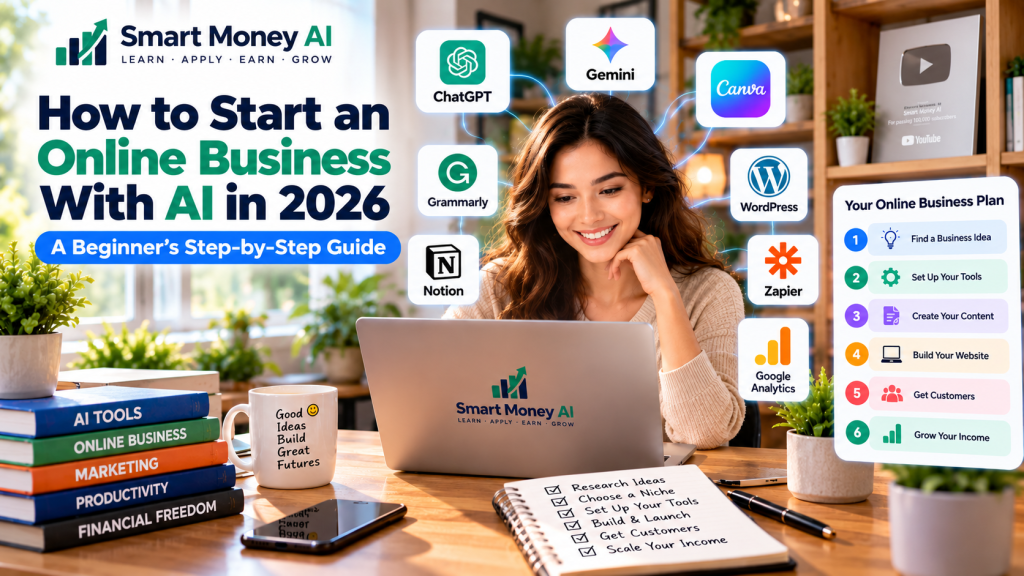
Starting an online business used to require significant technical knowledge, expensive software, and considerable time. Today, artificial intelligence (AI) can help beginners research business ideas, create digital content, organize daily tasks, and manage certain business processes more efficiently.
But AI does not automatically create a successful business. You still need a useful product or service, a clearly defined audience, a practical business model, and a willingness to learn.
If you’re wondering how to start an online business with AI in 2026, this beginner-friendly guide will walk you through the process, from choosing an idea to launching your first offer.
You’ll also learn which AI tools can help, what costs to consider, how to attract potential customers, and which common mistakes to avoid.
The goal is to help you build a realistic business foundation rather than chase promises of effortless income.
Table of Contents
1. How to Start an Online Business With AI: Understanding the Basics
An AI-powered online business is a business that uses artificial intelligence to assist with some of its operations.
AI might help you:
- Research customer needs.
- Generate and organize ideas.
- Draft marketing materials.
- Create initial designs.
- Develop website content.
- Analyze business information.
- Automate repetitive administrative tasks.
- Improve customer communication.
For example, someone selling downloadable planners could use AI to brainstorm product ideas, research customer questions, and prepare draft descriptions.
The business owner would still be responsible for checking the quality of the product, understanding customer needs, and delivering what was promised.
The key distinction: AI is a tool that supports the business. It is not a substitute for a valuable offer or responsible business management.
If you’re exploring different opportunities, read our guide to 10 legitimate ways to make money online for beginners to understand your options before choosing a business model.
2. Why Consider Starting an Online Business With AI?
AI can make certain business activities more accessible to beginners.
Lower Barriers to Getting Started
Many online businesses can begin with a laptop, internet access, and a small collection of software tools.
Some AI platforms offer free plans or limited free features, allowing you to explore an idea before investing in paid subscriptions.
However, actual startup costs depend on your business model. Website hosting, payment processing, advertising, software, and professional services may create additional expenses.
Faster Research and Planning
AI assistants can help organize your thinking.
For instance, you could ask an AI tool to compare the typical customer needs of three possible business niches.
This may give you a useful starting point, but you should validate the information through real customer conversations and independent research.
Support for Everyday Tasks
A small business owner often handles multiple responsibilities.
AI can assist with outlining blog posts, preparing email drafts, organizing project checklists, and suggesting improvements to customer-facing content.
That leaves more time for activities that require human judgment, such as understanding customers and improving products.
Opportunities to Develop Valuable Skills
Starting an AI-assisted business can also help you learn digital marketing, customer service, project management, and basic financial planning.
These skills remain useful even if your first business idea changes.
3. Choose the Right Online Business Model
Before selecting AI tools, decide what your business will actually sell.
Here are five beginner-friendly models worth considering.
A. Digital Products
Digital products include templates, planners, worksheets, ebooks, and other downloadable resources.
For example, you could create a budgeting spreadsheet designed for freelancers.
AI might help you research useful features or improve instructions, while you remain responsible for the spreadsheet’s accuracy and functionality.
Potential advantages:
- No physical inventory.
- Digital delivery.
- Opportunities to update products.
- Ability to serve customers in different locations.
Challenges:
- Competition.
- Customer acquisition.
- Product quality.
- Copyright and licensing requirements.
B. Freelance Services
Freelancing involves providing a service directly to clients.
Examples include writing, presentation design, research assistance, website content management, and administrative support.
AI can help with drafts, planning, and routine tasks, but the service must meet the client’s expectations.
A freelance business may be suitable for someone who already has a useful skill and wants to test demand before creating a larger company.
C. Online Education and Learning Resources
People regularly search for clear explanations, tutorials, and practical learning materials.
You could develop beginner-friendly guides, educational worksheets, or structured learning resources around a subject you understand well.
AI can help organize lessons and create practice exercises.
However, educational content must be accurate, original, and appropriate for its audience.
D. Affiliate Content Business
An affiliate business earns commissions when customers make qualifying purchases through referral links.
You might build a website that reviews software or explains how different tools work.
AI can support research organization and content planning, but recommendations should be based on reliable information and genuine value to readers.
Affiliate relationships must be disclosed appropriately.
For guidance on affiliate disclosures and endorsements, review the FTC’s Endorsement Guides and related resources.
E. Online Consulting or Support Services
Some businesses need assistance with digital organization, software setup, customer communication, or workflow improvement.
If you have the necessary expertise, you could provide clearly defined support services.
AI may help prepare checklists and documentation, but customers are paying for the quality and reliability of your work.
4. Step 1: Identify a Specific Audience and Problem
A common beginner mistake is starting with a tool instead of a customer problem.
Rather than asking, “What can I sell using AI?” ask:
“Who needs help, and what problem can I solve?”
For example:
- Freelancers may need better project-tracking templates.
- Small businesses may need clearer website content.
- Students may need structured study materials.
- Job seekers may need help organizing their professional portfolios.
- Local service providers may need assistance preparing customer information pages.
These are starting hypotheses, not proof of demand.
How AI Can Help
Try a prompt such as:
“Suggest 10 common organizational challenges faced by freelance graphic designers. Group them by urgency and suggest questions I can ask potential customers to validate each problem.”
Review the suggestions critically.
If you’re new to AI assistants, our step-by-step guide on how to use ChatGPT for beginners explains how to write prompts and get more useful responses.
Then look for evidence in relevant communities, customer reviews, search results, and conversations with potential buyers.
Your objective is to find a problem that people genuinely want solved.
5. Step 2: Validate Your Business Idea Before Spending Money
An interesting idea is not necessarily a profitable one.
Validation means collecting evidence that people want your proposed product or service.
Research Existing Alternatives
Look at businesses already serving your target audience.
Study:
- Their products or services.
- Their publicly listed prices.
- Customer reviews.
- Common complaints.
- Frequently asked questions.
- Features customers appreciate.
Competition is not automatically bad. It can indicate that a market exists.
However, you still need a clear reason why someone would choose your offer.
Speak With Potential Customers
Ask open-ended questions about their current challenges.
For example:
“What is the most frustrating part of organizing your freelance projects?”
Avoid asking only whether someone likes your idea. Positive comments do not necessarily translate into purchases.
Test a Small Offer
Before building a large website or purchasing multiple subscriptions, consider testing a simple version of your product or service.
This might be one downloadable template, a limited service package, or a small educational resource.
Pay attention to actual customer interest, feedback, and willingness to pay.
Important: No research method can guarantee sales. Validation reduces uncertainty but does not eliminate business risk.
6. Step 3: Create a Simple Business Plan
You do not need a complicated document to begin, but you should understand how the business is supposed to work.
For additional guidance, the U.S. Small Business Administration provides a practical resource on how to write a business plan.
Your initial plan can answer seven questions:
- Who is the target customer?
- What problem does the business solve?
- What product or service will you offer?
- How will customers discover the business?
- How much will you charge?
- What will it cost to deliver the offer?
- How will you measure progress?
Example: Digital Planning Templates
Imagine a business that sells project-management templates for independent professionals.
Target audience: Freelancers managing multiple client projects.
Problem: Difficulty tracking deadlines, revisions, and project details.
Product: A downloadable project-tracking template with instructions.
Marketing: Helpful tutorials, search-friendly educational articles, and demonstrations.
Revenue: Payments from individual template purchases.
Expenses: Design software, website or marketplace fees, transaction fees, and marketing costs.
AI could help draft the plan, but every financial assumption should be checked.
7. Step 4: Choose AI Tools Based on Your Actual Needs
You do not need ten subscriptions to start an online business.
Choose tools that solve specific problems.
If you’re unsure which AI applications to begin with, explore our guide to 10 best AI tools for beginners to understand their features and practical uses.
| Business Task | Example Tools | Practical Use |
|---|---|---|
| Planning and brainstorming | ChatGPT, Gemini | Organize ideas and questions |
| Graphic design | Canva | Create draft graphics and layouts |
| Writing improvement | Grammarly | Review clarity and grammar |
| Document organization | Notion | Organize projects and notes |
| Website publishing | WordPress | Publish pages and articles |
| Workflow automation | Zapier | Connect supported applications |
| Website performance analysis | Google Analytics | Review website activity |
Not every product in this table is primarily an AI application, and AI features may vary by plan.
Start With a Minimal Setup
A beginner might initially need only:
- One AI assistant.
- One design or document tool.
- One platform for publishing or selling.
- A spreadsheet for tracking finances.
Add more software only when a genuine business need appears.
Protect Customer Information
Never upload confidential customer records, passwords, payment details, or sensitive business documents into an AI tool without appropriate authorization and safeguards.
Review privacy settings, data-handling terms, and relevant legal requirements before using AI with customer information.
8. Step 5: Build Your Online Presence
Your business needs a place where potential customers can understand your offer.
Depending on the model, this might be a website, an online marketplace listing, or a professional portfolio.
Create a Clear Business Identity
Choose a name that is appropriate for your audience and does not conflict with existing trademarks.
Then prepare:
- A concise description of what you offer.
- A consistent visual identity.
- A professional contact method.
- Clear product or service information.
- Relevant customer policies.
Avoid spending weeks perfecting a logo before confirming that people want your offer.
Build a Simple Website
A beginner-friendly business website might include:
Home: Explain what the business does and who it helps.
About: Describe your background, approach, or relevant expertise.
Products or Services: Show what customers can purchase.
Contact: Provide a way to ask questions.
Policies: Include applicable privacy, refund, and other necessary information.
A website should work properly on mobile devices as well as desktop computers.
Use AI Carefully for Website Content
AI can prepare first drafts of headlines, product descriptions, and frequently asked questions.
However, you must check that every claim is accurate.
Do not publish invented testimonials, exaggerated results, or misleading product descriptions.
9. Step 6: Develop Your First Product or Service
Your first offer should be focused and manageable.
Avoid trying to launch a large collection of products immediately.
For a Digital Product
Suppose you want to sell a freelance project planner.
Your development process might include:
- Researching common planning problems.
- Listing the essential features.
- Creating a basic template.
- Testing calculations and functionality.
- Writing clear instructions.
- Asking a few potential users for feedback.
- Improving the product before launch.
AI may assist with planning and wording, but you should test the final product yourself.
For a Service Business
If you’re offering website content support, define exactly what the customer receives.
For example, a service package might include:
- A discovery questionnaire.
- A defined number of pages.
- Research and drafting.
- A specified number of revisions.
- An agreed delivery timeframe.
Clear boundaries help prevent misunderstandings.
Focus on Quality
Customers are not purchasing AI-generated output simply because AI was used.
They are paying for a useful result.
Accuracy, originality, reliability, and customer experience are essential.
10. Step 7: Set Prices and Understand Your Costs
Pricing is one of the most important decisions in an online business.
A price should reflect customer value, market conditions, operating costs, and the time required to deliver the offer.
Calculate Your Expenses
Possible expenses include:
- Domain registration and hosting.
- Software subscriptions.
- Marketplace commissions.
- Payment processing.
- Advertising.
- Contractors.
- Customer support.
- Taxes and professional services.
Some expenses are fixed, while others increase with sales.
Understand the Difference Between Revenue and Profit
Revenue is the money a business receives from sales.
Profit is what remains after relevant expenses.
For example, imagine a digital product generates $500 in sales during a month.
If platform fees, software, advertising, and other business expenses total $180, the remaining amount is $320 before any additional obligations such as applicable taxes.
This is a hypothetical illustration, not an income forecast.
Avoid Pricing Based Only on Competitors
Competitor prices can provide context, but your business may have different costs, quality standards, and customer expectations.
Test pricing thoughtfully and review it as you gather real feedback.
11. Step 8: Attract Your First Potential Customers
Even an excellent product needs a way to reach the right audience.
A beginner can explore several marketing channels.
Search Engine Optimization
Search engine optimization, or SEO, involves making helpful website content easier for search engines and users to understand.
For example, a business selling project planners might publish an article explaining how freelancers can organize multiple deadlines.
The article should genuinely answer the reader’s question rather than exist only to promote a product.
Educational Social Media Content
Short tutorials, practical tips, and product demonstrations can introduce your business to potential customers.
Choose platforms based on where your target audience spends time.
Consistency and usefulness matter more than posting large volumes of repetitive content.
Email Marketing
An email list can help you communicate with people who choose to receive updates.
You might share useful resources, product improvements, or new offers.
Follow applicable email marketing laws and provide appropriate unsubscribe options.
Professional Networking
For service businesses, professional communities and direct conversations can be valuable.
Focus on understanding people’s needs instead of sending generic promotional messages.
Use AI to Support Marketing
AI can help brainstorm article topics, draft social media outlines, or prepare alternative headline ideas.
You should still review everything for accuracy, originality, and relevance.
12. Step 9: Organize Daily Operations
As your business develops, administrative work can become time-consuming.
Start with a simple system.
Track Your Work
Maintain a list of:
- Customer inquiries.
- Orders or projects.
- Deadlines.
- Expenses.
- Payments.
- Feedback.
- Tasks requiring follow-up.
A spreadsheet may be sufficient for a small operation.
Create Repeatable Processes
For example, a freelance service workflow could follow these steps:
- Receive a customer inquiry.
- Clarify requirements.
- Provide a written proposal.
- Agree on scope and payment terms.
- Complete the work.
- Review quality.
- Deliver the project.
- Request feedback.
Documenting your process makes it easier to improve over time.
Automate Carefully
Automation tools can help with routine notifications, task creation, or transferring information between supported applications.
But automations can fail.
Test workflows, monitor results, and keep human review for sensitive customer decisions or financial activities.
For more practical ideas on managing everyday work efficiently, explore our guide to AI tools for productivity and discover ways to simplify routine tasks.
13. Step 10: Measure Results and Improve
Launching a business is only the beginning.
You need to understand what is working and what requires improvement.
Useful Beginner Metrics
Website visitors: How many people visit your website?
Customer inquiries: How many people ask about your offer?
Conversion rate: What proportion of relevant visitors or inquiries become customers?
Revenue: How much money does the business receive?
Expenses: What does it cost to operate?
Customer feedback: What do buyers appreciate or find confusing?
Not every metric is equally important for every business.
For a new freelance service, customer inquiries and completed projects may matter more than website traffic.
Make Small Improvements
Suppose visitors reach your product page but rarely purchase.
Possible reasons could include unclear descriptions, weak demonstrations, unexpected fees, or a mismatch between the offer and audience.
Investigate before making changes.
AI can help organize feedback into themes, but your decisions should be based on real evidence.
14. A Practical 30-Day Starting Plan
A simple schedule can help you avoid becoming overwhelmed.
Week 1: Research and Choose
- Select one target audience.
- Identify a specific customer problem.
- Research competing offers.
- Speak with potential customers.
- Choose one business model.
Goal: Develop a focused idea supported by initial evidence.
Week 2: Plan and Build
- Prepare a simple business plan.
- Choose essential tools.
- Create an initial product or service package.
- Estimate expenses.
- Test the offer.
Goal: Produce something useful that can be demonstrated.
Week 3: Prepare Your Online Presence
- Create a basic website or listing.
- Write clear descriptions.
- Set up an appropriate payment method.
- Prepare relevant policies.
- Test the customer experience.
Goal: Make it possible for customers to understand and purchase the offer.
Week 4: Launch and Learn
- Share helpful content.
- Introduce your offer to relevant audiences.
- Gather feedback.
- Track inquiries and expenses.
- Identify one or two improvements.
Goal: Learn from actual market responses.
This is an illustrative plan, not a promise that a complete business can always be launched in 30 days.
Some models require additional time, approvals, training, or legal preparation.
15. Common Mistakes When Starting an Online Business With AI
Believing AI Guarantees Income
AI tools can assist with work, but they cannot guarantee customers, sales, or profit.
Business results depend on demand, execution, competition, costs, and many other factors.
Purchasing Too Many Subscriptions
Paid tools can quickly become a significant expense.
Begin with essential software and upgrade only when the benefits justify the cost.
Creating Products Without Customer Research
A polished product is not necessarily useful.
Validate the problem before investing heavily in development.
Publishing Unchecked AI Content
AI-generated text may include inaccurate information, unsupported claims, or repetitive explanations.
Review and improve every important piece of customer-facing content.
Ignoring Copyright and Licensing
Do not assume that everything generated or discovered using AI can be used commercially without restrictions.
Check platform terms, source-material rights, and applicable intellectual property rules.
Neglecting Customer Service
Responding clearly, honoring commitments, and handling problems professionally help build trust.
Automation should support good service, not replace accountability.
Forgetting Legal and Tax Responsibilities
Business registration, taxes, privacy obligations, and consumer protection requirements vary by location and business activity.
In the United States, rules may differ at the federal, state, and local levels.
Consult appropriate official resources or qualified professionals when necessary.
16. How Much Money Can an AI-Powered Online Business Make?
There is no reliable universal income figure for an AI-powered online business.
Some businesses never become profitable. Others develop steady revenue over time.
Earnings depend on factors such as:
- The business model.
- Customer demand.
- Product quality.
- Pricing.
- Marketing effectiveness.
- Operating expenses.
- Competition.
- Time and experience.
A business that generates substantial sales can still lose money if its expenses are too high.
Rather than starting with an income target, focus on building a useful offer, understanding costs, and learning from customer feedback.
Sustainable business development is generally more valuable than chasing unrealistic income claims.
17. Frequently Asked Questions
Can a beginner start an online business with AI?
Yes. Beginners can use AI to assist with research, planning, writing, and organization. However, they still need to develop business skills and provide genuine value to customers.
Do I need coding skills?
Not necessarily. Many online business models use website builders, marketplaces, and no-code applications. Technical requirements depend on the business you choose.
Can I start with free AI tools?
Some AI platforms offer free access or limited free features. You may still need to pay for hosting, payment processing, software, or other operating expenses.
What is the easiest AI-assisted business for beginners?
There is no single easiest model for everyone. A small digital product or clearly defined freelance service may be manageable for someone with relevant skills, but each has its own challenges.
Do I need a website immediately?
Not always. Some businesses begin through marketplaces or professional platforms. A dedicated website can become useful for building a recognizable brand and communicating directly with customers.
Can AI run an online business automatically?
AI can assist with selected tasks, but reliable business operations still require human oversight, customer service, quality control, and financial responsibility.
Is starting an AI-powered business legal in the United States?
Using AI in a business is generally possible, but the business must comply with applicable laws, platform rules, intellectual property requirements, privacy obligations, and industry-specific regulations.
How long does it take to earn money?
There is no guaranteed timeline. Some businesses may attract customers relatively quickly, while others require substantial experimentation or never achieve meaningful sales.
Final Thoughts
Learning how to start an online business with AI in 2026 is not primarily about finding the most advanced technology.
Understanding how to start an online business with AI begins with identifying a real customer problem and building a practical solution.
AI can make research, planning, content preparation, and certain administrative tasks easier. However, your business still needs accurate information, useful products or services, responsible operations, and a realistic approach to marketing.
Start with one audience, one problem, and one focused offer.
Test your assumptions before spending heavily, learn from feedback, and improve gradually.
The most valuable role of AI is to help you work more effectively while you build the knowledge and experience needed to operate a real business.
Continue exploring Smart Money AI for beginner-friendly guides about AI tools, digital skills, and practical online business opportunities.
Editor’s Note: This article provides general educational information and does not constitute financial, legal, or tax advice. Business outcomes vary, and examples are illustrative rather than income guarantees.