
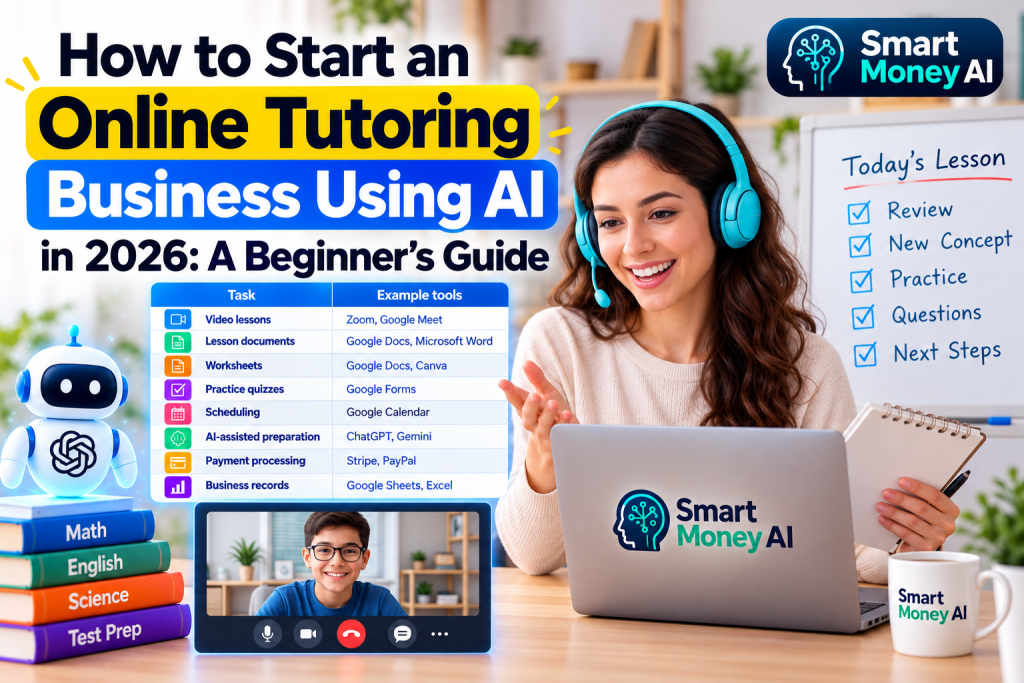
Starting an online tutoring business is one way to earn money from home by sharing knowledge and helping others learn. Whether you’re skilled in mathematics, English, science, languages, or digital skills, online tutoring can provide an opportunity to build a flexible service-based business.
In 2026, artificial intelligence is making certain tutoring tasks easier. AI tools can help tutors prepare lesson plans, create practice questions, develop worksheets, organize study materials, and manage routine administrative work.
However, successful tutoring still depends on subject knowledge, effective communication, patience, and the ability to understand individual learning needs. AI is most useful when it supports these skills rather than replacing them.
Learning how to start an online tutoring business using AI can help beginners reduce preparation time, improve lesson organization, and create a more professional learning experience.
You don’t necessarily need a teaching degree to offer every type of private tutoring service, although qualifications, background checks, licensing requirements, and platform rules may apply depending on your location, subject, and students’ ages.
In this beginner-friendly guide, you’ll learn how to choose a tutoring niche, use AI responsibly, set up your business, find students, price your services, and develop a realistic plan for getting started in the United States.
Table of Contents
1. What Is an AI-Assisted Online Tutoring Business?
An AI-assisted online tutoring business is a service where a tutor teaches students remotely while using artificial intelligence to support lesson preparation, learning activities, and business operations.
The tutor remains responsible for delivering lessons, explaining concepts, evaluating progress, and communicating with students or parents.
AI tools may assist with tasks such as:
- Preparing lesson outlines and teaching materials.
- Generating practice questions and quizzes.
- Explaining concepts in different ways.
- Creating revision schedules.
- Organizing administrative tasks.
- Drafting professional messages.
- Developing marketing content.
For example, an online mathematics tutor might use AI to generate ten algebra practice problems, review each answer for accuracy, and select appropriate questions for a student’s current ability.
The tutor would then teach the concepts, answer questions, and provide personalized feedback during the lesson.
This approach combines human teaching with AI-assisted preparation.
Can Beginners Start an Online Tutoring Business?
Yes, beginners can explore online tutoring if they have sufficient knowledge of a subject and can explain it clearly.
However, knowing a subject and teaching it effectively are different skills.
Before accepting paying students, beginners should practice explaining concepts, preparing structured lessons, and responding to common learning difficulties.
Some tutoring platforms require specific qualifications, experience, identity verification, or background screening.
Always review those requirements before applying.
2. Why Consider Online Tutoring in 2026?
Online tutoring allows tutors and students to connect without being in the same physical location.
Lessons can take place through video meetings, interactive whiteboards, shared documents, and other online learning tools.
Potential Benefits
Flexible scheduling
Tutors may be able to offer lessons during evenings, weekends, or other available hours.
Relatively low startup costs
Many tutors can begin with an existing computer, internet connection, and basic software.
Different subjects and audiences
Tutoring opportunities may include school subjects, language learning, adult education, test preparation, and professional skills.
Opportunities for repeat clients
Students who benefit from consistent support may book recurring sessions.
AI-assisted preparation
AI can help create first drafts of lesson materials and reduce some repetitive work.
Important Challenges
Online tutoring also involves competition, student acquisition, scheduling, lesson preparation, and customer service.
Income may fluctuate, especially during the early months.
AI-generated content can contain mistakes, and working with younger students may create additional privacy and safeguarding responsibilities.
An online tutoring business should therefore be treated as a professional service, not a guaranteed source of passive income.
3. Choose the Right Online Tutoring Niche
Choosing a tutoring niche is one of the first important decisions.
A niche defines the subject you teach and the type of student you want to help.
Rather than advertising every possible subject, beginners may benefit from starting with one area they understand well.
Popular Tutoring Categories to Explore
Academic subjects
- Elementary mathematics.
- Middle-school mathematics.
- High-school algebra.
- English reading and writing.
- Science fundamentals.
- Study skills.
Language tutoring
- Conversational English.
- English as a second language.
- Spanish for beginners.
- Other languages in which you are proficient.
Digital skills
- Basic computer skills.
- Microsoft Excel.
- Google Docs and Google Sheets.
- Presentation skills.
- Introductory programming.
Professional and adult learning
- Business communication.
- Workplace writing.
- Basic spreadsheet skills.
- Interview preparation.
Some subjects, particularly standardized test preparation or advanced academic instruction, may require specialized expertise.
How to Select Your Niche
Ask yourself:
- Which subject can I explain confidently?
- What age group or skill level can I teach effectively?
- What specific learning problem can I help solve?
- Do I have relevant qualifications or experience?
- Are people actively seeking tutoring in this subject?
- What are competing tutors offering?
You can review tutoring marketplace listings, parent communities, educational forums, and search results to understand the services being advertised.
Avoid assuming that a subject will be profitable simply because it is popular.
Your ability to teach it effectively matters just as much.
4. How to Use AI to Plan Your Tutoring Business
Understanding how to start an online tutoring business using AI begins with identifying your teaching strengths, selecting suitable subjects, and understanding your students’ learning needs. AI tools can help you organize these decisions and create a practical business plan.
AI can help organize your initial ideas before you invest money in software or advertising.
Tools such as ChatGPT and Google Gemini can assist with brainstorming, comparing business models, and developing preliminary plans.
For lesson planning, brainstorming, and preparing educational materials, you can explore ChatGPT by OpenAI. It can help draft lesson outlines, suggest practice activities, and organize tutoring ideas. Always review AI-generated information for accuracy before sharing it with students.
If you’re new to ChatGPT, read our step-by-step guide on how to use ChatGPT for beginners. It explains how to get started with AI prompts and use ChatGPT for practical everyday tasks, including planning and organizing ideas.
However, AI-generated market estimates and competitor information should not be treated as verified research.
Step 1: Define Your Tutoring Service
Start by deciding:
- Your subject.
- Your target student.
- Your lesson format.
- Your available teaching hours.
- Your initial pricing approach.
For example:
Service: Beginner Excel tutoring.
Audience: US adults learning workplace spreadsheet skills.
Format: One-to-one online sessions.
Lesson length: 60 minutes.
Goal: Help students understand formulas, formatting, and basic data organization.
Step 2: Ask AI to Organize Your Ideas
You can use the following prompt:
Example AI Prompt:
“Act as an online tutoring business planning assistant. I want to start a beginner-friendly online Excel tutoring service for adults in the United States. Help me create a simple business plan covering my target audience, service packages, essential equipment, lesson structure, possible startup expenses, and a 30-day launch checklist. Clearly label assumptions and avoid making guaranteed income claims.”
Review the suggestions carefully.
Use AI to organize your thinking, but verify costs, legal requirements, and platform policies independently.
5. Essential Tools for Starting an Online Tutoring Business
You do not need an expensive studio or a complicated technology setup to begin.
A reliable and comfortable teaching environment is more important than purchasing numerous subscriptions.
Basic Equipment
Computer or laptop
A computer capable of running video meetings and displaying lesson materials is usually sufficient.
Reliable internet connection
A stable connection helps reduce interruptions.
Microphone or headset
Clear audio makes lessons easier to follow.
Webcam
A camera can support face-to-face interaction where appropriate.
Quiet workspace
Choose a location with minimal background noise.
Digital writing tools
A mouse, tablet, stylus, or digital whiteboard may be useful for subjects requiring diagrams or calculations.
Useful Software Categories
| Task | Example tools |
|---|---|
| Video lessons | Zoom, Google Meet |
| Lesson documents | Google Docs, Microsoft Word |
| Worksheets | Google Docs, Canva |
| Practice quizzes | Google Forms |
| Scheduling | Google Calendar |
| AI-assisted preparation | ChatGPT, Gemini |
| Payment processing | Stripe, PayPal |
| Business records | Google Sheets, Excel |
These are examples rather than endorsements.
Free-plan limits, pricing, regional availability, age requirements, and commercial-use terms can change.
Choose only the tools you actually need.
6. Use AI to Create Professional Lesson Plans
Lesson preparation can consume significant time, particularly for new tutors.
AI can help generate a structured first draft that you can adapt to each student’s needs.
Writing clear instructions helps AI generate more useful teaching materials. For practical examples, read our guide on how to write better AI prompts in 2026. It covers techniques beginners can use to create more specific prompts for lesson plans, worksheets, quizzes, and other tasks.
Example: A 60-Minute Mathematics Lesson
Suppose you teach introductory algebra.
Ask AI:
“Create a 60-minute beginner algebra tutoring lesson for a student learning how to solve one-step equations. Include a five-minute review, a clear explanation, three worked examples, guided practice, independent practice, and a short assessment. Provide an answer key and identify common misconceptions.”
AI may suggest a structure such as:
| Activity | Time |
|---|---|
| Review previous knowledge | 5 minutes |
| Introduce the concept | 10 minutes |
| Demonstrate worked examples | 15 minutes |
| Guided practice | 15 minutes |
| Independent practice | 10 minutes |
| Review and feedback | 5 minutes |
This schedule is a starting point.
A student who needs more explanation may require additional time, while another student may be ready for more challenging activities.
Review AI-Generated Materials
Before using AI-generated lesson content:
- Verify calculations and factual explanations.
- Check the difficulty level.
- Remove confusing or irrelevant questions.
- Ensure instructions are age-appropriate.
- Confirm that examples support the learning objective.
- Review the answer key.
Never assume that an AI-generated worksheet is accurate simply because it looks professional.
7. Create Worksheets, Quizzes, and Practice Materials With AI
Practice materials help students reinforce what they learn during tutoring sessions.
AI can assist with creating questions, sample exercises, and revision activities.
Tutors can use Google Forms to prepare practice quizzes, collect student feedback, and review responses. Visit the official Google Forms website to explore its features and start creating online assessments for your tutoring sessions.
Example: English Grammar Worksheet
Use this prompt:
“Create a beginner-friendly English grammar worksheet containing 15 questions about subject-verb agreement. Include multiple-choice and fill-in-the-blank questions, an answer key, and short explanations. Use clear American English and avoid unnecessarily complicated vocabulary.”
You can then:
- Review every question.
- Correct mistakes.
- Adjust the difficulty.
- Format the worksheet in Google Docs.
- Share the finished material with the student.
Using Google Forms for Quizzes
Google Forms can be useful for creating quizzes and collecting student responses.
If you want to create interactive quizzes and collect student responses more efficiently, explore our beginner’s guide on how to use Google Forms with Gemini AI in 2026. It explains how to create forms, prepare questions with AI assistance, and organize responses using Google Sheets.
You can draft questions with AI, review them, and add them to a Google Forms quiz.
Where supported, Google Forms can help organize responses and score certain question types automatically.
Some Gemini-powered features may require eligible accounts or subscriptions.
Avoid Sharing Sensitive Student Information
When using general-purpose AI tools, do not enter students’ full names, contact details, school records, grades, personal circumstances, or other identifying information without appropriate authorization and a suitable privacy arrangement.
For minors, use extra care and follow applicable child privacy rules, parental consent requirements, and platform policies.
You can create most practice materials using fictional student profiles instead of real personal information.
8. How to Set Your Online Tutoring Prices
Pricing affects both your ability to attract clients and the sustainability of your business.
Your rate should reflect your expertise, preparation time, lesson duration, business expenses, and the value of your service.
Illustrative Pricing Example
The following amounts are hypothetical examples for planning, not verified national averages or guaranteed market rates.
| Tutoring service | Example hourly rate |
|---|---|
| Basic academic support | $20 |
| General subject tutoring | $30 |
| Specialized tutoring | $45 |
| Advanced subject tutoring | $60 |
Actual rates vary substantially by subject, experience, qualifications, location, and client demand.
Tutoring marketplaces may also deduct commissions or charge other fees.
Example Monthly Revenue Calculation
Suppose you charge $30 per session and provide ten paid one-hour sessions per week.
Weekly gross revenue:
10 × $30 = $300
Illustrative monthly gross revenue:
$300 × 4 = $1,200
This is gross revenue before taxes, software subscriptions, marketplace commissions, refunds, payment-processing fees, and other business expenses.
It also assumes all ten sessions are booked and paid for each week.
Actual earnings may be lower, particularly when starting.
Remember Your Unpaid Work
A one-hour lesson may require additional time for preparation, communication, scheduling, and recordkeeping.
For example, if a $30 lesson requires 30 minutes of unpaid preparation, the gross amount earned per working hour is effectively $20 before expenses.
Consider your total workload when deciding prices.
9. Where to Find Online Tutoring Students
Finding students is often one of the most challenging parts of starting an online tutoring business.
You can explore both tutoring marketplaces and independent client acquisition.
Option 1: Tutoring Marketplaces
Examples of platforms to research include:
Wyzant
A US tutoring marketplace where eligible tutors can create profiles and connect with potential students.
Preply
A platform known for language tutoring and other educational subjects, subject to its current tutor eligibility rules.
Outschool
An educational marketplace offering online learning experiences for children and teenagers, with specific educator eligibility and safety requirements.
These platforms have different fee structures, policies, qualifications, and onboarding processes.
Review their current official terms before creating an account.
Option 2: Create Your Own Tutoring Website
A simple website can explain:
- Your qualifications.
- The subjects you teach.
- Who your lessons are designed for.
- Your teaching approach.
- Session pricing.
- Available schedules.
- How potential clients can contact you.
You do not need a complex website to begin.
A clear, professional page describing your service may be sufficient.
Option 3: Build a Professional Online Presence
You can share useful educational content through appropriate channels, such as:
- YouTube tutorials.
- Educational blog posts.
- Professional networking platforms.
- Relevant community groups.
- Short educational videos.
For example, a mathematics tutor might publish a short explanation of a common algebra mistake.
This can demonstrate teaching ability and help prospective students understand the tutor’s style.
Follow community rules and avoid unsolicited promotional messages.
Option 4: Ask for Referrals
Satisfied adult clients or parents may recommend your services to others.
You can politely request feedback after students have had enough time to evaluate your teaching.
Do not fabricate reviews or promise specific academic results.
10. How to Market Your Tutoring Business Using AI
AI can assist with drafting promotional materials, but marketing should remain accurate and transparent.
Learning how to start an online tutoring business using AI also involves developing a clear marketing strategy. You can use AI to brainstorm promotional ideas, draft informative social media posts, and explain your tutoring services to prospective students and parents. Review every message before publishing to ensure it accurately represents your qualifications and services.
Create a Professional Tutor Profile
Your profile should explain:
- What you teach.
- Who you help.
- Your qualifications or relevant experience.
- Your lesson format.
- What students can expect.
- How to book a session.
Example AI Prompt for a Tutor Profile
“Write a friendly, professional tutoring profile for a beginner Excel tutor serving adults in the United States. Highlight patient teaching, practical exercises, one-to-one online lessons, and workplace spreadsheet skills. Avoid exaggerated claims, invented credentials, and guaranteed results. Keep the description under 150 words.”
Review the output before publishing it.
Create Educational Social Media Posts
AI can also suggest ideas for helpful content.
For example:
- Five common Excel mistakes beginners make.
- Three ways to improve reading comprehension.
- A simple introduction to algebra equations.
- How to organize a weekly study schedule.
- Common grammar mistakes in business emails.
Focus on genuinely useful content rather than publishing large amounts of repetitive AI-generated material.
11. Set Up Scheduling, Payments, and Student Communication
A professional tutoring service needs a reliable system for managing appointments and payments.
Scheduling
Use a calendar to track:
- Lesson dates.
- Student bookings.
- Available teaching hours.
- Rescheduled sessions.
- Preparation time.
You may also use scheduling software if your business grows.
Payments
Choose a payment method suitable for your location and business.
Before accepting payments, review:
- Transaction fees.
- Refund procedures.
- Payment disputes.
- Available countries.
- Account eligibility.
- Business recordkeeping requirements.
Cancellation Policy
Consider establishing a simple written cancellation policy.
It can explain how much notice is required, whether missed sessions are refundable, and how rescheduling works.
Communicate these terms before a client books.
Communicating With Parents
When tutoring minors, parents or guardians should generally be involved in arranging services and understanding communication arrangements.
Use appropriate, approved communication channels and avoid unnecessary private contact with children.
For businesses serving minors, safeguarding procedures are an essential part of professional operations.
12. Legal, Privacy, and Business Considerations in the USA
Starting an online tutoring business involves responsibilities beyond teaching.
For guidance on business planning, registration, licenses, and other startup requirements in the United States, review the U.S. Small Business Administration’s 10 Steps to Start Your Business guide.
If you are still planning your tutoring business, our beginner’s guide on how to start an online business with AI in 2026 explains the basic steps involved in choosing a business idea, organizing your workflow, and using AI tools to support your operations.
The exact requirements depend on your state, local jurisdiction, business structure, student population, and services.
Business Registration
Depending on your circumstances, you may operate as a sole proprietor or choose another legal structure.
Some locations require business licenses, registrations, or permits.
Check the relevant state and local government requirements.
Taxes
Tutoring income may be taxable.
Keep records of payments, refunds, fees, and business expenses.
US self-employment tax and estimated tax requirements may apply depending on your situation.
Online tutors who operate independently may have federal tax obligations, including reporting business income and paying self-employment taxes when applicable. For official guidance, visit the IRS Self-Employed Individuals Tax Center to understand tax responsibilities, recordkeeping, and estimated tax payments.
Consult official IRS guidance or a qualified tax professional for advice specific to your circumstances.
Working With Minors
Tutoring children may involve additional requirements, including:
- Background screening.
- Parental or guardian consent.
- Safe communication practices.
- Appropriate lesson-recording policies.
- Student data protection.
- Platform-specific safeguarding requirements.
Do not assume that every tutoring platform or location follows the same rules.
AI and Student Privacy
Avoid uploading identifiable student information to AI services without a valid reason, appropriate permissions, and an understanding of the service’s privacy terms.
If working with schools or educational organizations, additional privacy obligations may apply.
Review relevant policies before using student information with third-party tools.
13. Common Mistakes Beginners Should Avoid
Mistake 1: Offering Too Many Subjects
Trying to teach everything can make it difficult to build a clear reputation.
Start with a subject you know well.
Mistake 2: Relying Entirely on AI
AI can produce inaccurate explanations, unsuitable questions, or misleading answers.
Always review materials and teach using your own understanding.
Mistake 3: Setting Prices Without Considering Preparation Time
A low hourly rate may become unsustainable if every lesson requires extensive unpaid work.
Include preparation and administrative time in your calculations.
Mistake 4: Making Unrealistic Income Promises
Avoid marketing claims that guarantee better grades, test scores, employment, or financial outcomes.
Explain what your tutoring service provides without promising results beyond your control.
Mistake 5: Ignoring Student Feedback
Ask students what they find difficult and adjust your teaching accordingly.
Progress should guide lesson planning.
Mistake 6: Buying Too Many Tools
Beginners do not need subscriptions to every AI or education platform.
Start with a small, reliable set of tools.
Mistake 7: Ignoring Privacy and Safety
Protect student information and establish appropriate communication procedures, especially when working with minors.
14. A Practical 30-Day Plan to Start Your Online Tutoring Business
A 30-day plan can help you move from an idea to a basic service offering.
The goal is to prepare responsibly and begin looking for clients, not to guarantee bookings or income.
Week 1: Choose Your Niche and Research the Market
Days 1–2: Select one subject you can teach confidently.
Days 3–4: Identify your ideal student and the problems you can help solve.
Days 5–6: Review competing tutoring services, platform requirements, and example pricing.
Day 7: Write a simple business plan.
Week 2: Prepare Your Teaching Materials
Days 8–9: Set up your computer, video meeting software, and teaching workspace.
Days 10–11: Create sample lesson plans using AI assistance.
Days 12–13: Review and prepare worksheets, quizzes, and teaching resources.
Day 14: Conduct a practice lesson with a consenting adult volunteer or colleague.
Week 3: Build Your Professional Presence
Days 15–16: Prepare your tutor profile and service description.
Days 17–18: Choose an appropriate tutoring platform or create a simple website.
Days 19–20: Establish pricing, booking procedures, and cancellation terms.
Day 21: Review relevant business, tax, privacy, and safeguarding requirements.
Week 4: Begin Finding Students
Days 22–23: Publish your professional profile where permitted.
Days 24–25: Create helpful educational content demonstrating your teaching style.
Days 26–27: Respond to suitable tutoring inquiries.
Days 28–29: Review feedback from practice lessons or early clients.
Day 30: Evaluate what worked and plan your next month.
If you have not booked students by Day 30, that does not automatically mean your business idea has failed.
Review your positioning, teaching credentials, subject demand, pricing, and marketing approach before making adjustments.
15. How to Grow Your Online Tutoring Business
Once you have developed teaching experience and a consistent service, you can explore ways to improve operations.
Offer Structured Learning Packages
Instead of only offering individual lessons, you may create a series of sessions focused on a particular goal.
For example:
Beginner Excel Skills — Four-Session Package
- Session 1: Spreadsheet basics.
- Session 2: Formulas and calculations.
- Session 3: Sorting and organizing data.
- Session 4: Practical workplace exercises.
Packages can help clarify what students will learn.
Avoid promising that every student will achieve the same results.
Develop Reusable Teaching Materials
Create your own lesson templates, practice activities, and checklists.
AI can help draft materials, but you should verify accuracy and respect copyright and licensing restrictions.
Improve Your Teaching Skills
Continue developing subject knowledge, communication techniques, and lesson-planning skills.
Student outcomes depend on effective teaching, not simply the number of AI tools you use.
Track Business Performance
Use a spreadsheet to record:
- Number of inquiries.
- Booked sessions.
- Cancellations.
- Gross revenue.
- Business expenses.
- Preparation hours.
- Repeat bookings.
This information can help you make better business decisions over time.
16. Frequently Asked Questions
Can I start an online tutoring business without a teaching degree?
Some private tutoring opportunities do not require a formal teaching degree. However, individual platforms, subjects, employers, and jurisdictions may have specific qualifications or screening requirements. You should have sufficient subject knowledge and teaching ability before accepting students.
Can I use ChatGPT to prepare online tutoring lessons?
Yes. ChatGPT can help draft lesson plans, practice questions, explanations, and learning activities. Tutors should verify the content, adapt it to students’ needs, and avoid sharing sensitive student information without appropriate authorization.
How much money can I make from online tutoring?
Earnings vary based on the subject, experience, pricing, number of booked lessons, platform fees, and other expenses. There is no guaranteed income. Build projections using realistic assumptions rather than advertised earning claims.
Is online tutoring a good side business for beginners?
It may be suitable for people who have strong subject knowledge, enjoy explaining concepts, and can commit to reliable lesson schedules. Beginners should also consider the time required to prepare lessons and find clients.
What AI tools are useful for online tutors?
ChatGPT and Gemini can help with lesson ideas and draft teaching materials. Google Forms can support quizzes, while Google Docs and Sheets can help organize resources and business records. Tool availability, pricing, and features may change.
Do I need a website to start tutoring online?
Not necessarily. Some tutors begin through marketplaces or professional networks. A website may become useful for explaining your services and building an independent presence.
Can AI teach students instead of a human tutor?
AI can provide explanations and practice assistance, but it can also make mistakes and may not understand a student’s individual needs. A human tutor remains responsible for teaching quality, feedback, and appropriate learning support.
How do I find my first online tutoring student?
Start with a clear tutoring niche and professional profile. Explore suitable marketplaces, publish useful educational content, and communicate your services through appropriate networks. Finding clients takes time, and results are not guaranteed.
17. Final Thoughts: Is an AI-Assisted Online Tutoring Business Worth Starting?
An online tutoring business can be a practical way to turn existing knowledge into a professional service.
AI tools can help with lesson preparation, worksheets, quizzes, marketing drafts, and routine organization. These capabilities may reduce some administrative work, allowing tutors to spend more time improving their teaching.
Understanding how to start an online tutoring business using AI is about combining your teaching knowledge with practical digital tools. Start with one subject, create helpful learning materials, and focus on delivering quality lessons. As your experience grows, you can improve your services and gradually expand your tutoring business.
However, building a successful business still requires subject expertise, reliable communication, thoughtful lesson planning, appropriate pricing, and consistent efforts to attract and retain students.
If you’re learning how to start an online tutoring business using AI, begin with one subject, prepare a few high-quality lessons, and test your teaching approach before expanding.
Focus on delivering genuine educational value rather than expecting immediate or guaranteed income.
Quick Summary
- Choose a subject you understand and can teach confidently.
- Research student needs and tutoring platform requirements.
- Use AI to assist with lesson preparation, not replace teaching judgment.
- Set prices that account for preparation time and expenses.
- Establish safe communication, privacy, and payment procedures.
- Build a professional profile and begin looking for students.
- Track results and improve your service gradually.
Editor’s Note
This guide is intended for general educational and informational purposes. Platform features, tutoring requirements, business regulations, tax rules, and software pricing can change. Always verify current information through official sources before making business decisions. Income examples are illustrative and do not represent guaranteed results.
Ready to get started? Choose one subject you can teach confidently and use the 30-day plan above to take your first practical steps toward building an AI-assisted online tutoring business.