
Finding potential customers is one of the biggest challenges for small businesses. A company may offer excellent products or services but still struggle to connect with people who are interested in buying them.
This creates an opportunity for people who can help businesses identify relevant prospects, organize contact information, and improve their customer acquisition processes.
Artificial intelligence can make some of these activities more efficient.
AI tools can assist with business research, organizing publicly available information, identifying patterns, and preparing personalized marketing materials.
However, successful lead generation requires more than collecting names and email addresses. It involves understanding customer needs, protecting personal information, following marketing regulations, and delivering genuinely useful results.
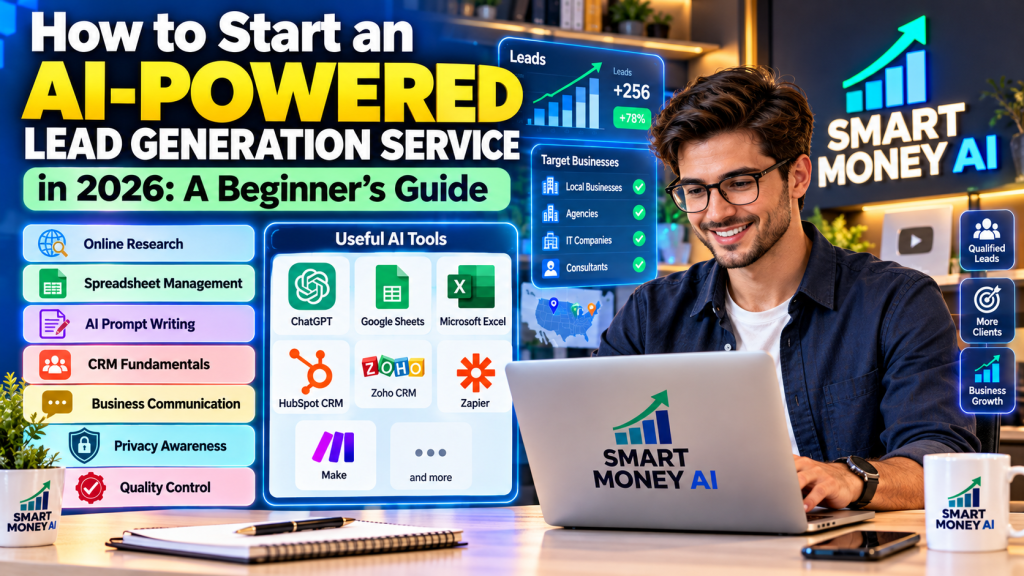
If you want to learn how to start an AI-powered lead generation service in 2026, this beginner-friendly guide explains the essential skills, tools, business models, and practical steps involved.
You will also learn how to choose a niche, create service packages, find your first clients, and build a sustainable business without making unrealistic income promises.
Table of Contents
1. How to Start an AI-Powered Lead Generation Service: The Basics
An AI-powered lead generation service helps businesses identify and evaluate potential customers using a combination of research, digital tools, and artificial intelligence.
A lead is a person or organization that may have an interest in a company’s products or services.
For example, a company selling bookkeeping software might want to reach small business owners who need accounting solutions.
A lead generation service could help that company identify suitable businesses, organize relevant company information, and prioritize potential opportunities.
What Does AI Do in Lead Generation?
AI can assist with tasks such as:
- Researching industries and customer segments
- Summarizing business information
- Organizing lead research
- Categorizing prospective customers
- Identifying possible customer needs
- Preparing outreach drafts
- Analyzing campaign results
- Supporting customer relationship management
AI should support human judgment rather than replace it.
If you’re exploring other ways to build a business using artificial intelligence, read our guide on How to Start an Online Business With AI in 2026: A Beginner’s Step-by-Step Guide. It explains how beginners can identify business opportunities, select useful AI tools, and develop practical online services.
Information generated by AI can be incomplete or inaccurate, so important details must be verified.
Example
Imagine a web design agency that specializes in helping local restaurants.
The agency wants to identify restaurants that may benefit from website improvements.
An AI-assisted lead researcher could help organize information from legitimate business sources, identify relevant website characteristics, and prepare a list of potential business opportunities.
The researcher should verify findings and avoid claiming that a restaurant needs a service without sufficient evidence.
2. Why Small Businesses Use Lead Generation Services
Small businesses often have limited time and resources.
Business owners may spend most of their day serving customers, managing employees, and handling operations.
Researching potential customers can become another demanding responsibility.
Save Research Time
A lead generation service can help businesses organize prospect research more efficiently.
Improve Targeting
Instead of approaching unrelated businesses, companies can focus on prospects that match their ideal customer profile.
Organize Sales Opportunities
Structured lead information helps sales teams understand which organizations may be relevant.
Support Marketing Campaigns
Businesses can use appropriately obtained and verified prospect information to plan compliant marketing activities.
Improve Follow-Up Processes
A well-organized customer relationship management system can help teams track conversations and next steps.
Understand Potential Demand
Research can reveal industries, customer segments, and business challenges worth exploring.
However, lead generation does not guarantee sales.
Results depend on the market, service quality, customer needs, competition, and the client’s sales process.
3. What Services Can You Offer?
You do not need to offer every lead generation service immediately.
Beginners can start with a narrow, clearly defined service.
Business Prospect Research
Research companies that match a client’s target customer profile.
If you want to explore additional AI-assisted services for business clients, read our guide on How to Offer ChatGPT-Powered Services to Small Businesses in 2026. It explains how beginners can use ChatGPT to support practical business tasks and develop service offerings for small businesses.
Deliver a structured list of relevant businesses with verified business information.
Lead Qualification
Review prospects against agreed criteria.
For example, a client might want businesses operating in a particular industry, location, or company-size range.
CRM Data Organization
Help clients organize existing, lawfully obtained customer or prospect information.
This can include:
- Removing duplicate entries
- Standardizing company names
- Categorizing industries
- Organizing sales stages
- Identifying missing information
Customer Research Summaries
Prepare short reports explaining why a particular business segment may be relevant to a client’s services.
Outreach Content Preparation
Draft professional messages that a client can review before sending.
Outreach should follow applicable laws, platform rules, and the recipient’s communication preferences.
Lead Generation Reporting
Prepare reports showing:
- Prospects researched
- Records verified
- Qualification results
- Campaign responses
- Meetings booked, when applicable
- Data quality issues
Do not present unverified contacts as qualified leads or promise results that you cannot substantiate.
4. Step 1: Choose a Profitable Business Niche
Choosing a niche helps you understand the needs of a specific type of client.
Rather than offering lead generation to every business, focus on an industry where you can learn the customer profile and buying process.
Potential Niches
Marketing Agencies
Agencies may need research support to identify businesses that could benefit from their services.
Web Design Companies
Web designers may look for businesses planning to create or improve their websites.
Business Consultants
Consultants may need help identifying organizations that fit their specialization.
Commercial Cleaning Companies
Cleaning businesses may target offices, retail locations, and other commercial properties.
IT Service Providers
IT companies may research organizations that could benefit from technical support or managed services.
Business Software Providers
Software businesses may need structured research about companies in particular industries.
How to Evaluate a Niche
Consider these questions:
- Do businesses in this niche regularly seek new customers?
- Can you clearly identify their ideal customers?
- Is legitimate business information available for research?
- Can you deliver a measurable service?
- Are there privacy or industry-specific restrictions?
- Do you understand the basic terminology of the industry?
Beginner Recommendation
Start with one business-to-business niche.
For example, you could offer prospect research for small web design agencies serving local businesses.
A narrow niche makes it easier to develop repeatable research methods.
5. Step 2: Understand Your Client’s Ideal Customer Profile
An ideal customer profile, often called an ICP, describes the type of customer a business wants to serve.
Understanding this profile is essential.
Without it, you may spend time researching businesses that are not relevant to your client.
Important ICP Details
Industry: What type of business is the client targeting?
Location: Which cities, states, or regions are relevant?
Business Size: Does the client serve solo professionals, small teams, or larger organizations?
Services Needed: What business problems does the client help solve?
Budget Fit: Can the target customer reasonably afford the client’s service?
Decision-Making Process: How does the organization typically evaluate purchases?
Example ICP
A client provides website maintenance services.
Their ideal customer profile might include:
- Industry: Independent professional service businesses
- Location: Selected cities in the United States
- Business size: Small organizations
- Need: Ongoing website maintenance
- Exclusions: Businesses outside the client’s service area
The researcher can then evaluate prospective organizations against these criteria.
Important Tip
Do not assume a business has a particular problem based only on its industry or appearance.
Use verifiable information and label uncertain observations appropriately.
6. Step 3: Learn the Essential Digital Skills
AI can accelerate research, but basic digital skills remain important.
Online Research
Learn how to locate reliable business information.
Prioritize official business websites, authorized directories, and other legitimate sources.
Spreadsheet Management
Learn how to use spreadsheets to organize research.
Important skills include:
- Sorting
- Filtering
- Removing duplicates
- Creating consistent columns
- Checking data accuracy
- Preparing reports
AI Prompt Writing
Learn how to write clear instructions for AI tools.
A useful prompt explains the task, context, requirements, and expected output.
Writing effective AI prompts can help you organize business research, analyze information, and prepare professional reports. To develop this skill, explore our guide on How to Write Better AI Prompts in 2026: 12 Practical Techniques for Beginners, which explains practical prompting techniques for getting clearer and more useful AI responses.
CRM Fundamentals
Understand how customer relationship management software organizes prospect and customer information.
Business Communication
Learn how to write professional messages and explain your services clearly.
Privacy Awareness
Understand why personal information should not be collected, shared, or retained unnecessarily.
Quality Control
Learn how to verify important research findings before delivering them to clients.
These skills will help you provide a more dependable service.
7. Step 4: Choose AI Tools for Lead Generation
You can start with a small set of tools.
Avoid paying for several subscriptions before you understand what your service requires.
ChatGPT
You can explore ChatGPT through its official website to learn how AI can assist with business research, organizing information, drafting professional communications, and developing structured lead generation workflows.
ChatGPT can assist with:
- Developing customer profile templates
- Summarizing information you provide
- Organizing research notes
- Creating qualification checklists
- Drafting professional reports
- Preparing outreach examples
AI-generated claims should be verified against reliable sources.
Google Sheets
Google Sheets is a useful tool for organizing prospect research, managing lead information, tracking progress, and collaborating with clients. Beginners can explore its features through the official Google Sheets website.
Google Sheets can help you organize business research.
You can create columns for:
- Company name
- Official website
- Industry
- Location
- Business description
- Research source
- Verification date
- Qualification status
- Notes
Microsoft Excel
Microsoft Excel helps beginners organize lead research, sort and filter business information, analyze data, and prepare professional reports. You can explore the official Microsoft Excel website to learn about its spreadsheet features and how they support business research and lead generation workflows.
Excel provides spreadsheet tools for sorting, filtering, analyzing, and reporting structured information.
HubSpot CRM
HubSpot CRM helps businesses organize customer information, manage sales pipelines, and track interactions with potential clients. Beginners interested in offering AI-powered lead generation services can explore the official HubSpot CRM website to understand how customer relationship management tools support business workflows.
HubSpot offers customer relationship management tools that can help businesses organize contacts, companies, and sales activities.
Available features depend on the selected plan.
Zoho CRM
Zoho CRM is a customer relationship management platform that helps businesses organize customer information, manage potential sales opportunities, and track interactions with prospects. Beginners can visit the official Zoho CRM website to explore how CRM software supports lead management, sales organization, and business productivity.
Zoho CRM provides tools for managing sales information, customer relationships, and business workflows.
Zapier
Zapier supports integrations and automation workflows between compatible applications.
For example, a permitted workflow might transfer approved form submissions into a CRM.
Make
Make is another automation platform that supports visual workflows across compatible services.
Choosing Your First Tools
A beginner might start with:
- An AI assistant for research organization
- A spreadsheet for structured records
- A CRM for client-approved information
- An automation tool only when necessary
Always review subscription costs, permissions, and data-handling requirements before connecting services.
8. Step 5: Create a Simple Lead Research Workflow
A repeatable workflow helps you deliver consistent results.
Stage 1: Understand the Assignment
Ask the client to provide:
- Target industry
- Target locations
- Company-size requirements
- Excluded business types
- Qualification criteria
- Required research fields
- Permitted data sources
- Delivery format
Stage 2: Identify Relevant Businesses
Research businesses using legitimate sources.
Examples may include official company websites and directories that permit the intended use.
Avoid bypassing website restrictions, harvesting private information, or using unauthorized scraping methods.
Stage 3: Record Business Information
Create a spreadsheet containing the agreed fields.
Stage 4: Verify Research Findings
Check important details against appropriate sources.
Mark information that cannot be verified.
Stage 5: Qualify Prospects
Evaluate each business against the client’s criteria.
Stage 6: Remove Duplicates
Check for repeated company records.
Stage 7: Prepare the Deliverable
Provide a clean, organized report.
Stage 8: Review With the Client
Ask the client whether the results match the agreed requirements.
Use feedback to improve future research.
9. Step 6: Use AI to Organize Lead Research
One of the safest and most practical uses of AI is organizing information that you have already obtained appropriately.
Example AI Prompt: Organize Business Research
“Act as a business research assistant. Organize the company information I provide into a structured table with columns for company name, industry, location, official website, business description, and verification status. Do not invent missing information. Mark any unavailable details as ‘Not verified.'”
Example AI Prompt: Create Qualification Criteria
“Help me create a lead qualification checklist for a web design agency targeting small professional service businesses in the United States. Include industry relevance, geographic fit, business size, and evidence of potential service needs. Do not make unsupported assumptions about individual companies.”
Example AI Prompt: Summarize Research Notes
“Summarize these business research notes into three sections: verified facts, possible opportunities requiring further investigation, and missing information. Clearly distinguish facts from assumptions.”
Example AI Prompt: Prepare a Client Report
“Create a professional summary of this prospect research project. Include the research scope, number of records reviewed, qualification criteria, verification process, limitations, and recommended next steps. Use only the data provided.”
Important AI Research Rule
Never assume that an AI-generated company name, email address, website, or business claim is accurate.
Verify important details before including them in a client deliverable.
10. Step 7: Build a Professional Lead Research Spreadsheet
A structured spreadsheet makes your service easier to review.
Example Spreadsheet
| Company | Industry | Location | Official Website | Status |
|---|---|---|---|---|
| Sample Company A | Web Services | Austin, TX | To verify | Research pending |
| Sample Company B | Business Consulting | Denver, CO | To verify | Under review |
| Sample Company C | IT Services | Raleigh, NC | To verify | Qualified example |
These are fictional examples, not verified business leads.
Recommended Columns
Company Name: Official business name.
Industry: Business category.
Location: Relevant business location.
Website: Verified official website.
Research Source: Where the information was obtained.
Verification Date: When the information was checked.
Qualification Status: Whether the business matches the client’s criteria.
Research Notes: Relevant factual observations.
Keep Your Data Clean
Use consistent formats for names, dates, and categories.
Avoid collecting personal information that is not necessary for the agreed service.
Apply appropriate access controls when handling client data.
11. Step 8: Create Your First Lead Generation Service Package
If you’re learning how to start an AI-powered lead generation service, creating a clear service package is an important step because it helps potential clients understand exactly what you offer and what results they can expect.
A clear service package helps potential clients understand what they are buying.
Avoid vague promises such as “unlimited leads” or “guaranteed customers.”
Package 1: Starter Business Research
Suitable for: Small businesses testing a new customer segment.
Possible Deliverables:
- Agreed number of researched businesses
- Basic company information
- Industry and location verification
- Qualification notes
- Spreadsheet delivery
Package 2: Qualified Prospect Research
Suitable for: Businesses with a clearly defined customer profile.
Possible Deliverables:
- More detailed company research
- Qualification against agreed criteria
- Duplicate checking
- Verification notes
- Organized reporting
Package 3: Ongoing Research Support
Suitable for: Businesses that need regular prospect research.
Possible Deliverables:
- Recurring research batches
- CRM organization
- Data quality reviews
- Weekly or monthly reports
- Workflow improvements
Define the Scope Clearly
Your service agreement should explain:
- What counts as a completed record
- Which information fields are included
- How qualification is determined
- What sources may be used
- How data will be delivered
- How corrections are handled
- Whether outreach is included
Clear expectations help prevent misunderstandings.
12. Step 9: Decide How Much to Charge
Pricing depends on the complexity of the assignment and the value of the work.
There is no universal rate for AI-assisted lead generation services.
Common Pricing Models
Fixed Project Fee
Charge an agreed amount for a clearly defined research project.
Hourly Pricing
Charge for the time spent researching, verifying, organizing, and reporting.
Monthly Retainer
Provide recurring services for a monthly fee.
Per Verified Record
Charge for records that meet clearly defined requirements.
This model requires careful quality standards.
Illustrative Pricing Exercise
Suppose you estimate that a research project will require:
- 5 hours of research
- 2 hours of verification
- 1 hour of reporting
Total estimated time: 8 hours.
If your hypothetical target service rate is $25 per hour:
8 × $25 = $200.
This is a calculation example, not a verified market rate or earnings prediction.
Actual pricing should account for your experience, costs, scope, market demand, and applicable taxes.
Avoid Underpricing Complex Work
Research quality matters.
A smaller set of carefully verified business records may be more useful than a large spreadsheet filled with irrelevant or outdated information.
13. Step 10: Build a Portfolio Before Finding Clients
A portfolio helps demonstrate your skills.
You do not need to publish private customer information or claim experience you do not have.
Create a Sample Research Project
Choose a fictional client scenario.
For example:
“A website maintenance company wants to research small professional service businesses in a selected US city.”
Prepare:
- A sample ideal customer profile
- A research methodology
- A spreadsheet template
- A qualification checklist
- A short example report
Use fictional company records unless you have a legitimate reason to include verified public business information.
What Should Your Portfolio Show?
Your portfolio should demonstrate:
- Clear research methods
- Organized spreadsheets
- Accurate categorization
- Thoughtful qualification criteria
- Professional presentation
- Respect for privacy
- Honest reporting
Portfolio Tip
Label practice projects clearly as demonstrations.
Do not present fictional results as actual client work.
14. Step 11: Find Your First Clients
Once you understand your service and have a portfolio, you can begin exploring client opportunities.
Freelance Marketplaces
Freelance platforms may have projects involving:
- Business research
- CRM data organization
- Prospect qualification
- Market research
- Sales operations support
Review each platform’s eligibility requirements, terms, fees, and policies before using it.
Professional Networking
Professional communities can help you understand the needs of businesses in your chosen niche.
Participate in relevant discussions and build a reputation for useful contributions.
Your Existing Network
People who already know your work may be able to provide referrals or introduce you to relevant opportunities.
Local Business Communities
Business associations and professional events can provide opportunities to learn about common customer acquisition challenges.
Portfolio Website
A simple professional website can explain:
- Your services
- Your specialization
- Your research process
- Sample deliverables
- Contact information
Focus on Relevant Clients
Do not send the same generic message to large numbers of unrelated businesses.
A smaller number of relevant, respectful conversations is generally a better starting point.
15. Step 12: Write a Professional Client Proposal
A proposal should explain the problem you can help solve and the work you will deliver.
Example Proposal
Subject: Business Prospect Research Support
Hello,
I provide structured business prospect research and data organization services for companies that want to identify potential business customers more efficiently.
My services include researching businesses that match an agreed customer profile, verifying relevant company information, organizing findings in spreadsheets, and preparing qualification reports.
I use AI-assisted tools to support research organization and reporting, while reviewing important information for accuracy.
If this type of research would be useful for your team, I would be happy to discuss your target market and the scope of a potential project.
Thank you for your consideration.
What Makes a Good Proposal?
A professional proposal should be:
- Relevant to the recipient
- Clear about the service
- Honest about your experience
- Specific about possible deliverables
- Respectful of communication preferences
Do not claim guaranteed sales, invent customer testimonials, or imply that you have already researched a company when you have not.
16. Step 13: Understand Lead Generation Laws and Privacy
Legal compliance is one of the most important parts of a lead generation business.
The United States has federal and state requirements that may apply to commercial communications, consumer information, and marketing activities.
Rules can also depend on the communication channel, industry, recipient, and location.
CAN-SPAM Act
The CAN-SPAM Act establishes requirements for covered commercial email messages.
Important principles include:
- Avoid misleading sender information.
- Use truthful subject lines.
- Identify advertising when required.
- Provide a valid physical postal address where required.
- Include an appropriate opt-out mechanism.
- Honor valid opt-out requests within the applicable deadline.
Business-to-business commercial emails are not automatically exempt.
Telephone Consumer Protection Act
The Telephone Consumer Protection Act, or TCPA, and related rules may apply to certain marketing calls and text messages.
Requirements depend on the communication method and circumstances.
Do not assume that a publicly listed phone number can be used for automated marketing.
State Privacy Laws
Some US states have privacy laws that may apply to collecting, processing, sharing, or selling personal information.
Applicability depends on factors such as business activities, data categories, and statutory thresholds.
Platform Rules
Professional networking sites, directories, and other services may restrict automated collection or use of their information.
Review applicable terms and obtain necessary permissions.
Data Minimization
Collect only information needed for the legitimate service.
Avoid gathering sensitive personal information unnecessarily.
Data Security
Use appropriate access controls and secure storage.
Do not upload confidential client information into AI tools without authorization and an appropriate understanding of the service’s data practices.
Important Note
This article provides general educational information, not legal advice.
Businesses should consult qualified professionals when evaluating applicable marketing, privacy, and data protection requirements.
17. Step 14: Automate Repetitive Work Responsibly
Automation can help with routine tasks, but it should not eliminate important quality checks.
If you want to learn how to automate everyday business activities, explore our guide on How to Automate Repetitive Tasks With AI in 2026: A Beginner’s Guide. It explains how beginners can use AI-powered workflows to save time, organize tasks, and improve productivity while maintaining human oversight.
Zapier is an automation platform that connects different applications and helps streamline repetitive business tasks. Beginners can explore the official Zapier website to learn how automated workflows can support lead research, spreadsheet updates, CRM management, and other administrative activities while maintaining human oversight.
Make is a visual automation platform that allows users to connect applications and create automated workflows. Beginners can explore the official Make website to learn how automation can help organize lead research, update spreadsheets, manage CRM records, and reduce repetitive administrative work while maintaining data accuracy and privacy.
Suitable Automation Examples
Spreadsheet Formatting
Automatically apply consistent formatting to approved records.
Duplicate Detection
Flag records that may contain duplicate company information.
Status Updates
Move approved research records between supported workflow stages.
Report Preparation
Generate summaries from reviewed data.
Client-Approved Form Processing
Transfer information submitted through an authorized form into an approved CRM.
Tasks That Need Human Review
- Confirming whether a prospect meets qualification criteria
- Verifying company information
- Reviewing outreach content
- Handling personal information
- Checking consent and opt-out requirements
- Interpreting ambiguous research findings
Avoid Risky Automation Practices
Do not use automation to:
- Bypass website access restrictions
- Harvest private contact information
- Evade anti-spam controls
- Send unsolicited bulk messages without appropriate compliance review
- Fabricate lead qualification results
- Ignore recipient opt-out requests
A reliable business should prioritize accuracy, privacy, and client trust.
18. Step 15: Measure the Quality of Your Service
Tracking performance helps you understand whether your research is useful.
Useful Performance Metrics
Research Accuracy
How many reviewed records contain accurate information?
Qualification Rate
What percentage of researched businesses match the agreed customer profile?
Duplicate Rate
How often do repeated records appear?
Completion Time
How long does it take to deliver the agreed research?
Correction Rate
How many records require changes after review?
Client Satisfaction
Does the client consider the research relevant and useful?
Example Quality Report
Suppose you research 100 fictional business records.
After verification:
- 80 meet the agreed qualification criteria.
- 10 do not match the target profile.
- 5 are duplicates.
- 5 require additional verification.
This example demonstrates reporting categories; it is not an industry benchmark.
Focus on Meaningful Outcomes
A large number of records does not necessarily indicate high-quality work.
Your goal should be to deliver useful, accurate, and appropriately sourced information.
19. Common Mistakes Beginners Should Avoid
Mistake 1: Trying to Serve Every Industry
Different industries have different customer needs.
Solution: Begin with a focused niche.
Mistake 2: Trusting AI-Generated Information Without Verification
AI can generate inaccurate company details.
Solution: Verify important facts using reliable sources.
Mistake 3: Confusing Business Records With Qualified Leads
A company appearing in a directory does not automatically mean it is interested in buying.
Solution: Define qualification criteria and distinguish potential fit from confirmed interest.
Mistake 4: Collecting Unnecessary Personal Information
Excessive data collection can create privacy risks.
Solution: Limit information to what is genuinely needed.
Mistake 5: Ignoring Marketing Regulations
Improper outreach can create legal and reputational problems.
Solution: Understand applicable requirements before launching campaigns.
Mistake 6: Promising Guaranteed Sales
Lead research cannot guarantee that prospects will become customers.
Solution: Promise defined deliverables rather than unsupported outcomes.
Mistake 7: Buying Too Many Tools
Subscription costs can accumulate quickly.
Solution: Start with essential tools and expand only when needed.
Mistake 8: Delivering Poorly Organized Spreadsheets
Unclear records are difficult for clients to use.
Solution: Maintain consistent formatting and clear column definitions.
Mistake 9: Skipping Client Feedback
Research may miss the client’s expectations.
Solution: Review a small sample before completing a large project.
Mistake 10: Ignoring Data Security
Careless handling of client information can cause serious problems.
Solution: Use appropriate storage, access controls, and approved workflows.
20. A Seven-Day Learning Plan for Beginners
You can use the following plan to explore the skills involved in an AI-powered lead generation service.
Day 1: Learn Lead Generation Fundamentals
Understand the difference between prospects, leads, and qualified opportunities.
Research common business-to-business customer acquisition methods.
Day 2: Choose a Niche
Select one industry.
Write a basic description of the type of business you want to serve.
Day 3: Build an Ideal Customer Profile
Create a sample ICP for a fictional client.
Include industry, location, business size, and qualification criteria.
Day 4: Practice AI-Assisted Research Organization
Use an AI assistant to create spreadsheet templates and research checklists.
Avoid entering sensitive or confidential information.
Day 5: Build a Sample Spreadsheet
Create fictional company records.
Practice sorting, filtering, categorizing, and checking for duplicates.
Day 6: Prepare a Portfolio Sample
Create a short demonstration report.
Explain your methodology, verification approach, and limitations.
Day 7: Design Your First Service Package
Define:
- Your target client
- Research scope
- Deliverables
- Quality standards
- Pricing approach
- Turnaround expectations
- Privacy safeguards
At the end of the week, review what you have learned and identify skills that need further practice.
21. Frequently Asked Questions
What is an AI-powered lead generation service?
It is a service that uses AI-assisted tools alongside human research to help businesses identify, organize, and evaluate potential customer opportunities.
Can beginners start a lead generation service?
Beginners can learn the necessary skills and create practice projects. Providing paid services requires the ability to deliver accurate work and comply with applicable requirements.
Do I need coding skills?
Many research and spreadsheet tasks can be completed without coding. Some advanced automation projects may require additional technical knowledge.
Is AI lead generation completely automated?
No. Reliable lead generation still requires human oversight, verification, and responsible data handling.
Which AI tools can help with lead generation?
AI assistants, spreadsheets, CRM platforms, and approved automation tools can support different parts of the workflow.
How much money can I make?
Earnings vary widely and are not guaranteed. Results depend on client demand, pricing, service quality, competition, and operating costs.
Can I work from home?
Many business research and data organization tasks can be performed remotely, depending on client requirements and applicable rules.
Do I need a website?
A website is not always necessary to begin learning or offering services, but a professional portfolio can help explain your capabilities.
Is it legal to collect business information?
Legality depends on the information, collection method, intended use, applicable laws, and source restrictions. Public availability does not automatically authorize every use.
Can I send marketing emails to businesses?
Commercial email may be subject to federal and state requirements. Review applicable rules before conducting outreach.
Should I purchase lead lists?
Purchased lists can present accuracy, permission, privacy, and compliance concerns. Evaluate their provenance, permitted uses, and legal requirements carefully.
Can AI verify every lead automatically?
No. AI-generated findings should be reviewed, and important information should be verified using appropriate sources.
22. Final Thoughts
Learning how to start an AI-powered lead generation service begins with understanding customer research, developing essential digital skills, and choosing reliable AI tools. Beginners should focus on delivering accurate business information, respecting privacy regulations, and building professional relationships with clients. With consistent practice and responsible AI use, this service can become a practical online business opportunity.
Starting an AI-powered lead generation service in 2026 can be an opportunity for people interested in business research, digital marketing, data organization, and AI-assisted workflows.
However, success depends on delivering genuine value.
Businesses need relevant, accurate, and useful prospect information—not simply large spreadsheets filled with unverified records.
Begin by learning the fundamentals of lead research and customer qualification.
Choose a focused niche, build a repeatable workflow, and practice organizing business information.
Use AI tools to improve efficiency while maintaining human oversight.
Most importantly, respect privacy, follow applicable marketing rules, and communicate honestly about what your service can deliver.
With consistent practice and careful attention to quality, you can develop useful skills and evaluate whether this type of service fits your long-term business goals.
Editor’s Note
This guide is for educational purposes and does not provide legal, financial, or business guarantees.
AI tools, subscription prices, marketing regulations, and platform policies may change.
Readers should verify current requirements and consult qualified professionals when necessary.
Your Next Step
Choose one business-to-business niche and create a fictional client profile.
Then build a sample lead research spreadsheet containing company information fields, qualification criteria, verification status, and research notes.
Use this exercise to practice the skills required for a professional, responsible AI-assisted lead generation service.